
An International Women’s Day 2026 Blog by Jenny Holden and Rebecca Calder (Kore Global) and Machteld Ooijens and Sharawwat Islam (Truvalu), with the support of the Embassy of Switzerland in Bangladesh.
Introduction
On International Women’s Day 2026, the global call for Rights, Justice, and Action for All Women and Girls reminds us that advancing gender equality and climate action requires more than intention – it requires investment. In today’s context of declining Official Development Assistance (ODA) and growing climate finance needs, accelerating gender-smart climate adaptation and mitigation will depend on mobilising capital more strategically, strengthening partnerships, and more deliberate alignment between finance and social and environmental impact.
At its core, this is also a question of rights and justice. Women and girls—who contribute least to climate change—are often among those most exposed to its impacts, yet they remain disproportionately excluded from the financial resources needed to adapt, rebuild, and lead solutions.
Nowhere is this more evident than at the intersection of climate change and gender inequality. Climate shocks deepen existing disparities in access to land, finance, decent work, and decision-making. At the same time, gender inequalities weaken economic systems and reduce communities’ capacity to adapt. Addressing one without the other risks entrenching vulnerability rather than building resilience.
Finance sits at the centre of this nexus. How capital is structured, targeted, and deployed will determine whether climate action accelerates inclusion — or bypasses those most capable of driving locally-grounded solutions. Small and medium-sized enterprises (SMEs) that empower women as employees, supply chain workers, and consumers play a critical role in driving climate innovation and resilience. These businesses are already emerging as powerful drivers of green solutions, yet their potential remains largely untapped.
It is against this backdrop that, with the support of the Embassy of Switzerland in Bangladesh, Kore Global and Truvalu partnered to analyse Bangladesh’s gender-smart climate investment landscape. Combining Truvalu Bangladesh’s deep experience in SME impact finance and sustainable investments with Kore Global’s global expertise in gender equality and gender-lens investing, we examined how finance can better support climate resilience through a gender lens.
In this blog, we share key insights from that analysis — and outline practical priorities to help investors, financial institutions, and policymakers move from ambition to aligned, investment-driven impact.
The gender and climate investment landscape in Bangladesh
Drawing on consultations with financial institutions, investors, development actors, and entrepreneurs, our analysis identified four core insights.
Insight 1: Strong policy architecture—but capital is not yet aligned
Bangladesh has established an impressive policy foundation linking climate resilience and gender equality, with a number of existing frameworks embedding gender considerations within national climate ambition.
In the financial sector, the Bangladesh Bank has issued Green Banking Guidelines and a Sustainable Finance Policy that integrates gender into sustainable lending frameworks. Gender-responsive budgeting and climate budget tagging further demonstrate systemic intent.
However, policy ambition has not yet translated into sufficient capital flows:
- Sustainable finance targets are often guidance rather than binding commitments.
- Climate finance continues to concentrate on large mitigation projects.
- Annual adaptation investment (USD 2–3 billion) falls well short of the estimated USD 8 billion required.
More broadly, gender and climate finance continue to be addressed in silos. While “green finance” is increasingly recognised, the concept of gender-smart climate finance remains poorly understood, limiting the development of integrated financial products and investment pipelines.
The enabling environment exists but the challenge is operationalisation—embedding gender across investment processes, product design, and capital allocation decisions.
Insight 2: SMEs—especially those led by women—face a persistent financing gap
Bangladesh’s SME sector faces an estimated USD 2.8 billion financing gap, with approximately 60% of women-owned SMEs’ financing needs unmet. Access to climate finance is even more limited: only 3.4% of SMEs have explored green financing, and just 0.9% have successfully accessed it.
Part of the challenge lies in limited awareness and technical capacity across the ecosystem. Existing climate finance frameworks are often perceived as overly technical and difficult to navigate, reducing their accessibility and on-the-ground application. Many research participants—including entrepreneurs and financial institutions—remain unaware of available green financing mechanisms and refinancing schemes offered by the Central Bank, leading to underutilisation of concessional funding opportunities.
As one woman entrepreneur explained:
“Many women-led small businesses are already contributing to sustainability… but when it comes to green or climate finance they are often left behind. They don’t know what sustainability or climate finance means, or how to show that their businesses are green.”
Structural barriers also persist including traditional collateral requirements linked to land ownership and high transaction costs for small-ticket lending. Many banks therefore prefer large corporate portfolios, while microfinance institutions dominate last-mile lending. SMEs—particularly growth-oriented women-led enterprises—often fall in between as a “missing middle”.
Without greater awareness, capacity-building, and tailored financial instruments, SMEs working at the gender-climate nexus will continue to be bypassed by mainstream climate finance.
Insight 3: Gender integration is often compliance-driven, not transformative
Across the ecosystem, gender is acknowledged—but unevenly embedded.
Through our consultations we identified a number of Development Finance Institutions and other actors driving mainstreaming efforts through Technical Assistance and funding windows.
However this too falls short of meaningful action:
- Gender screening is frequently checklist-based.
- Explicit gender-linked covenants in deal structuring are rare.
- Monitoring focuses on outputs (e.g., number of women reached) rather than agency, quality employment, or leadership pathways.
Investors often prioritise women’s ownership or board representation, while overlooking opportunities to influence employment practices, supply chains, and gender-responsive product design. A shift is needed from reporting compliance to embedding gender across the full investment lifecycle—from pipeline sourcing to value creation and impact measurement.
Insight 4: Women entrepreneurs are central to climate resilience—but systematically underserved
In Bangladesh, entrepreneurs in climate-vulnerable sectors such as agriculture, fisheries, and light manufacturing face overlapping constraints, including flooding-related supply chain disruptions, salinity intrusion, and heat-related productivity losses. Women entrepreneurs face additional structural barriers: while many have access to microfinance, they are significantly less likely to access formal SME finance, growth capital, and commercial banking networks. Constraints around collateral ownership, business formalisation, and integration into financial and trade networks further limit investment readiness and resilience-building capacity.
Yet evidence consistently shows that women-led businesses demonstrate strong repayment performance and reinvest in household and community resilience.
Climate finance that bypasses women-led SMEs risks missing one of the most effective multipliers for adaptation and inclusive growth.
From insight to action: Strategic recommendations
Delivering on the promise of rights, justice, and action for women and girls requires moving from policy ambition to real capital deployment.
Our analysis highlights four strategic priorities:
1. Design financial products that work for women-led and gender-inclusive climate enterprises
Develop concessional credit lines, blended finance structures, flexible collateral models, and climate-risk insurance tailored to women-led and gender-inclusive SMEs. Product innovation must align with central bank frameworks to ensure scalability.
2. Embed gender across the investment cycle
Move beyond compliance. Investors should integrate gender into sourcing, due diligence, structuring, and portfolio management — supported by gender data and stronger impact metrics. Targeted Technical Assistance and risk-sharing mechanisms can accelerate this shift.
3. Pair capital with capability
Women-led and gender-inclusive SMEs need more than finance. Business development support, climate adaptation and mitigation advisory, technology access, and financial literacy are critical to strengthening investment readiness and long-term resilience.
4. Crowd in capital through partnerships
Multi-actor partnerships — linking financial institutions, investors, ecosystem enablers, women’s business associations, climate experts, and development partners — can build pipelines and reduce perceived risk. Blended finance will be key to unlocking scale.
Turning insight into investment
This International Women’s Day calls for Rights, Justice, and Action for All Women and Girls. In the context of climate change, this means ensuring that women have not only the right to participate in economic and climate decision-making, but also fair access to the financial resources needed to adapt, innovate,and lead.
Bangladesh has laid important foundations: progressive climate policies, a growing sustainable finance agenda, and dynamic women entrepreneurs already driving adaptation and innovation. The opportunity now is to align financial systems with this momentum — ensuring that climate capital reaches the SMEs and women-led enterprises that anchor community resilience.
Turning climate ambition into climate justice requires practical tools that help financial institutions and investors act.
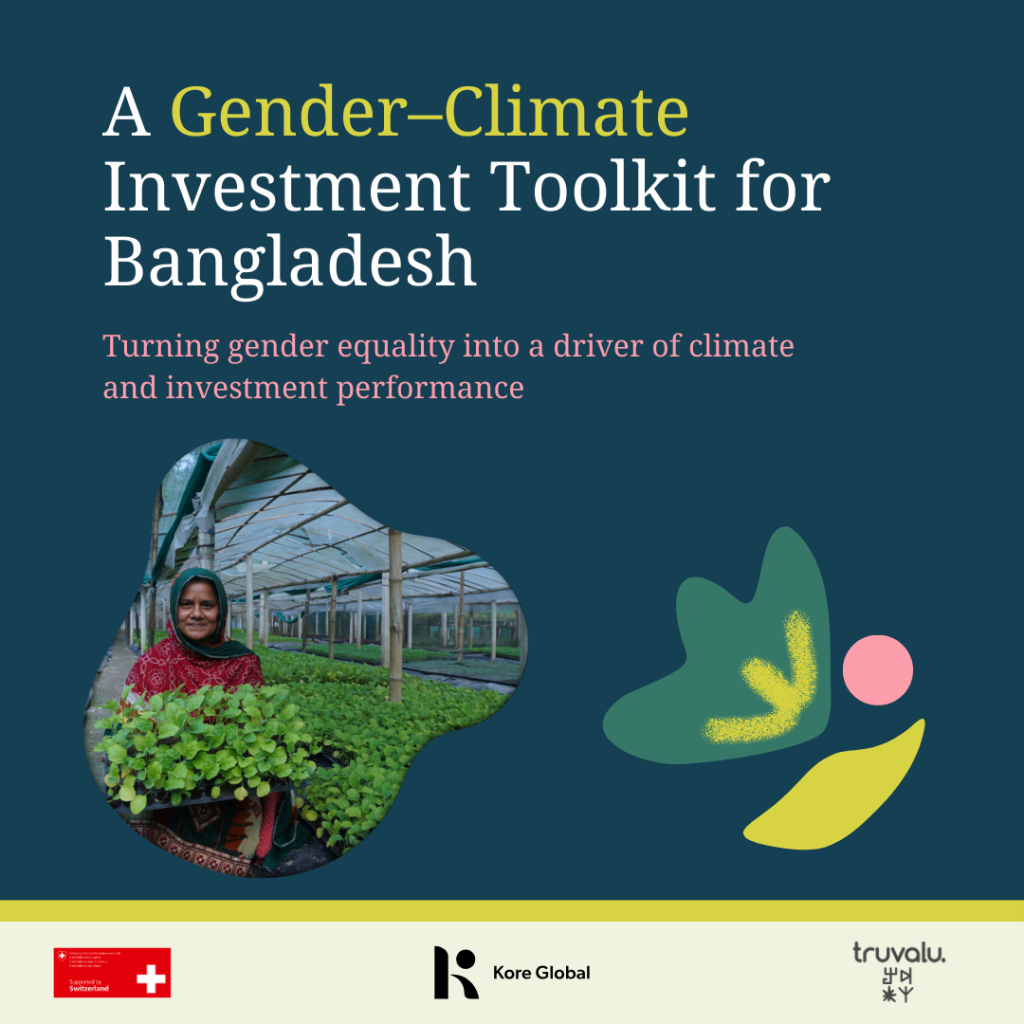
To support this shift, Kore Global and Truvalu — with the support of the Embassy of Switzerland in Bangladesh — have developed a practical Gender & Climate Investment Toolkit.
The Toolkit translates analysis into action. It equips financial institutions, investors, policymakers, and development partners with practical guidance to
- Embed gender across the climate investment lifecycle
- Structure gender-smart financial products
- Strengthen due diligence and impact measurement
Importantly, the Toolkit is not limited to one market. It is currently being piloted in Bangladesh, Kenya, and Colombia — allowing us to test, refine, and adapt its application across diverse climate-vulnerable and emerging market contexts.
Ensuring women entrepreneurs and gender-inclusive SMEs can access climate finance is not only an economic opportunity — it is a matter of rights, justice, and inclusive climate action.
Because in the climate–gender nexus, what we give — in capital, partnership, and commitment — we collectively gain in resilience, prosperity, and equity.
If you would like to learn more about the Gender & Climate Investment Toolkit — or explore collaboration opportunities in Bangladesh and other emerging economies — we invite you to get in touch.
Jenny Holden: Jenny@Koreglobal.org
Rebecca Calder: Rebecca@Koreglobal.org
Machteld Ooijens: Machteld@Truvalu-group.com
Sharawwat Islam: Sharawwat@Truvalu-group.com