

The “just transition” has become one of the most widely used phrases in climate policy — and one of the most contested. In theory, it promises that the shift away from fossil fuels will be managed fairly, leaving no worker or community behind. In practice, debates continue to rage about whose work counts, whose risks are factored in, and whose labour gets to be called “green.” We have been grappling with these questions as part of our research for the Donor Committee for Enterprise Development (DCED) on care, climate, and private sector development. A recent piece by Jessica Espinoza (CEO of 2X Global) argues that a transition that concentrates capital in the same hands as before is not “just” — it is merely low-carbon. We agree. Yet even in the most gender-smart climate finance conversations, something foundational is still missing from the frame: how investing in the care economy is essential to ensuring a just transition.
The word that keeps getting left out
Women’s central roles in areas such as community resilience, water systems, and energy access are increasingly recognised in gender and climate discussions. These are all critical. But there is an overarching category that cuts across each of these areas, but that rarely appears in climate finance discourse: care. This includes the paid and unpaid labour of raising children, supporting elderly relatives, nursing the sick, securing water and food, and sustaining households when climate shocks compromise livelihoods and social support systems.
This is not a semantic point. When care is not named, it is not seen – and when it is not seen, it is not funded. The result is that the very infrastructure holding climate-vulnerable communities together – care – remains systematically invisible to capital allocators, while the women providing that infrastructure are left absorbing shock after shock, with little investment in their capacity to do so.
The climate crisis is also a care crisis
The relationship between climate change and care is not incidental. It is structural. As our DCED research shows, climate-related shocks — e.g. heatwaves, floods, droughts, displacement — do not simply disrupt economies in the aggregate. They also increase the volume and intensity of unpaid care work, and they do so along already-unequal gendered lines.
When water sources dry up, women walk further to fetch water. When floods destroy and disrupt essential infrastructure, women care for those who are sick and displaced. When heatwaves send children and elderly relatives into health crises, women are the first responders — often without compensation, recognition, or the option to stop. Globally, women already perform more than three-quarters of all unpaid care work (ILO, 2022). Climate change is rapidly intensifying that burden.
This is what researchers have begun calling the “climate time tax” (Ngunjiri et al., 2025) — the additional hours climate shocks extract from women’s days. These are hours that cannot simultaneously be invested in a business, a training programme, or a green job. It is one of the most direct mechanisms by which climate change reinforces gender inequality, yet care remains almost entirely absent from just transition frameworks.
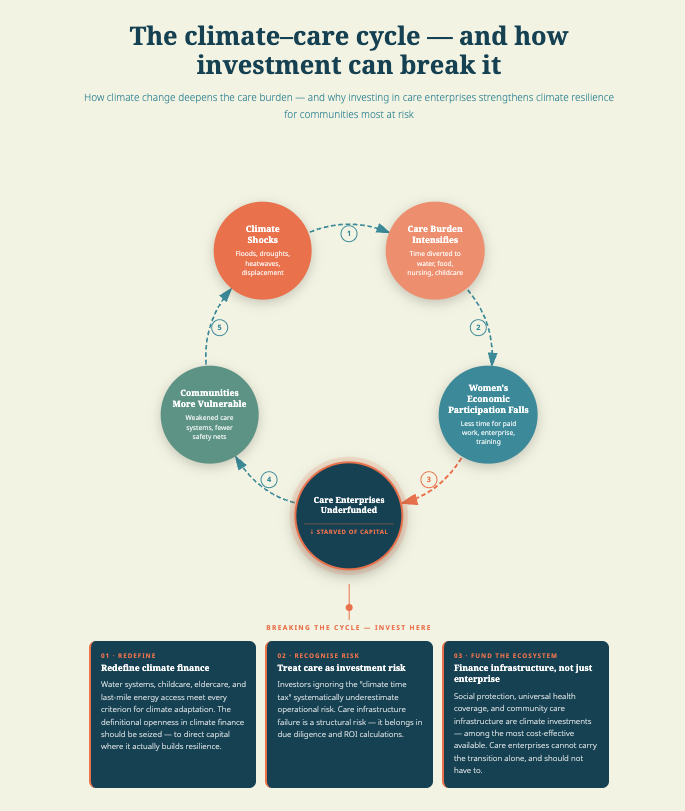
For an interactive version of the above image, click here.
What counts as climate finance and who gets left out
The exclusion of care from climate finance is neither accidental nor is it surprising. It is the predictable outcome of defining “climate finance” in ways that reflect whose labour has historically been counted — and whose has not.
Today, climate capital flows overwhelmingly towards mitigation: technology, hardware, energy infrastructure, and transport systems. These are sectors with familiar venture capital trajectories, legible to investors shaped by a particular model of what “bankable” looks like. Adaptation and resilience, by contrast, are chronically underfunded. Current adaptation finance flows to low and middle-income countries (approx. $28 billion in 2022) are 12 to 14 times smaller than the actual annual need. And within adaptation, anything that looks like care — because it is relational, local, context-specific, and disproportionately carried out by women — is treated as social expenditure rather than economic infrastructure, and is therefore dismissed as insufficiently “investable” within most prevailing finance models, including climate finance. And when investors fail to price care infrastructure into their models, this is not just an ethical oversight — they are systematically underestimating operational risk, particularly in climate-exposed geographies where women’s labour underpins the enterprises they fund.
The lack of an agreed-upon definition of what counts as ‘climate finance’ compounds this challenge. There is no internationally agreed standard for what counts as climate finance (Shishlov and Censkowsky 2022). In the absence of such a standard, estimates of progress towards global climate commitments vary wildly. In practice, existing development finance is often partially or fully reclassified as climate finance (even when climate objectives were not central to design) or climate indicators are simply layered into existing investments.
But the fact that the definition of climate finance is open to interpretation can be seen as either a problem to be solved or an opportunity to be seized — and we think it is the latter. If climate finance has no fixed borders, then the argument for expanding those borders to include care infrastructure becomes not just legitimate but urgent. Financing water access, childcare, eldercare, community health systems, and clean energy for last-mile communities meets any serious definition of climate adaptation. The question is whether we are willing to say so, and to design incentive structures that follow that logic rather than defaulting to what already attracts capital.
Care jobs are green jobs
Advocates in the just transition space have rightly challenged the narrow focus on protecting workers in carbon-intensive industries — e.g. coal miners and oil workers, etc. — as the central concern of a fair transition. This framing – however understandable politically – defaults to a masculinised vision of “work” and overlooks the millions of women already doing low-carbon, community-sustaining labour every single day.
Care jobs are, by definition, green jobs (ILO, 2024). They produce, on average, 26 times fewer greenhouse gas emissions than manufacturing jobs, and 1,500 times fewer than jobs in the fossil fuel sector (DCED 2025). The ILO estimates that investment in care could create nearly 300 million jobs globally by 2035 — the majority held by women and in formal employment. These are not aspirational figures. This capacity already exists, in the hands of women who are currently doing this work without adequate pay, protection, or investment.
A just transition that ignores care infrastructure is not just incomplete. It is actively reinforcing the inequalities it claims to redress by continuing to treat women’s care labour as an infinite, free resource that the transition can lean on without reciprocating.
Insights from enterprises at the forefront of the gendered care-climate nexus
Our research for the DCED included direct conversations with women-led enterprises at the intersection of care and climate — and what we found was a picture of genuine innovation operating under conditions of persistent underinvestment.
In Kenya, AgeWatch Africa Foundation provides professional eldercare to vulnerable older persons in Nairobi and northern Kenya, deploying predominantly female caregivers through both a care centre and home-based services. When climate shocks hit — and in Kenya they hit with increasing severity — AgeWatch does not retreat. During the 2024 flooding season alone, the organisation supported over 1,200 households. To protect its caregivers from the compounding burden of serving high-need clients whilst managing their own household emergencies, AgeWatch introduced a job-sharing model: standard shifts were reduced and redistributed so that caregivers could manage both professional and personal responsibilities without burning out. The result was stronger staff retention, more consistent care for elderly clients, and an enterprise model that treated its workforce’s additional unpaid care realities as an operational given rather than an inconvenient exception. The organisation has also developed a detailed proposal for a solar-powered community borehole that would provide year-round water security to the care centre and surrounding community — a project with obvious multiplier effects for the community, including towards climate resilience, reducing women’s unpaid labour, and elder wellbeing. Despite shopping the proposal to multiple funders, they have not secured support at the time of writing. This is precisely the kind of climate resilience investment that should be attracting capital.
In the remote islands of East Nusa Tenggara, Indonesia, Komodo Water builds solar-powered water infrastructure for last-mile communities where water collection has always been designated women’s work. When their systems reduced a six-hour water journey to ten minutes, women in the community expressed enormous relief. “They never thought it would happen,” founder Shana Fatina told us. This is what care infrastructure, properly funded and designed, actually looks like in practice. It sits at the precise intersection of climate adaptation and reduction in unpaid domestic care work that climate finance consistently fails to reach.
In Kenya, Tanzania, and Nigeria, Solar Sister distributes clean energy products, such as solar lights and clean energy cookstoves, through women entrepreneurs in rural communities. These products reduce rural women’s time spent on unpaid care work, such as collecting fuel, as well as reducing the need to care for children with respiratory illnesses through a reduction in indoor air pollution. During erratic rainy seasons, many of Solar Sister’s women entrepreneurs — who are also smallholder farmers — are forced to divert their entire attention and capital towards protecting harvests, setting their enterprises aside entirely. The “conflicting attention” their programme lead describes is not a personal failing. It is the climate time tax playing out at the enterprise level, in real time, with real income consequences. Solar Sister, a woman-led enterprise that is fully embedded in the contexts in which it operates, understands this and is working with the women entrepreneurs they support to devise solutions to address this challenge and enable them to continue earning a living all year round, while supporting women in their communities to access clean energy products.
These examples illustrate that care enterprises are not peripheral actors in the just transition. They are its frontline. They are reducing carbon emissions, enabling women’s economic participation, delivering climate adaptation, and absorbing the care deficits that climate change keeps generating. And they are chronically, structurally underfunded.
One of the best ways that climate finance can be gender-smart is to be care-smart
In recent years, a growing coalition of institutions — including the UNFCCC through its Belém Gender Action Plan, the 2X Climate Finance Taskforce (powered by the EIB, EBRD, and others), and the World Bank and IFC — have called for “gender-smart” climate finance, and have argued that investments that overlook gender are missing both impact and risk.
But gender-smart approaches, as currently practised, focus overwhelmingly on women’s representation in governance and ownership — important but insufficient metrics. A care-smart approach demands something more. It requires investors to ask not just who leads this enterprise, but what happens to care when this investment lands? E.g. Does it reduce women’s unpaid care burden or increase it? Does it recognise care workers as climate-relevant economic actors? Does it invest in the social infrastructure — childcare, eldercare, health coverage, social protection — without which women-led enterprises cannot function, let alone scale?
There are a number of toolkits focused on gender-smart climate finance, including recent work Kore Global has been leading in partnership with Truvalu and SDC. For those looking to go a step further and seeking guidance on investing at the care-climate nexus, our Care-Climate-Gender Rubric, developed in partnership with IDRC, goes further: it provides indicators specifically designed to measure how investments deliver care-climate impact for women workers, women consumers, and women engaged in supply chains. The goal is to make the care-climate nexus legible to investors — because what can be measured is more likely to be financed.
We are not alone in making this argument
The Just Transition and Care (JTC) Network — an international network of scholars, union representatives, women’s organisations, and environmental justice activists — has been arguing that caregivers, care infrastructure, and social protection must be recognised as central to any genuinely just transition, not afterthoughts within it. Their work has been making the political and conceptual case with rigour.
What our DCED research adds is a private-sector development lens and, crucially, a business case. There is substantial room for investors, blended finance vehicles, and public-private partnerships to join this call — not as philanthropists, but as actors who recognise care economy enterprises as investable, high-impact, and strategically positioned at the climate resilience frontier. The question is no longer whether the argument is sound. It is whether the capital will follow.
What needs to change
The transition we build will reflect the choices we make now about what counts as climate adaptation work, what counts as a green job, and whose labour we are willing to see, measure, and value. Three shifts are essential.
Redefine climate finance to include care. The definitional flexibility that currently allows climate finance to mean almost anything should be harnessed deliberately — to direct capital towards care-enabling investments in water systems, childcare facilities, eldercare, healthcare, and last-mile energy access. These meet every serious criterion for climate adaptation. Treat them, measure them, and fund them as such.
Treat unpaid care as a risk variable. Investors who do not factor the climate time tax into their return projections are systematically underestimating operational risk, especially for enterprises dependent on women’s labour in geographies particularly vulnerable to climate change. Caregiver burnout, erratic agricultural seasons, and the cascading effects of care infrastructure failure are structural risks, and they belong in investor due diligence and ROI calculations.
Finance the infrastructure, not just the enterprise. While their inclusion is essential to a just transition, women-led care MSMEs cannot carry the transition alone, and they should not have to. Programme teams working on private sector development are already navigating these trade-offs in real time — struggling to balance employment outcomes against longer-term climate impact, particularly as traditional bilateral donors slash funding envelopes and shorten programme timelines. The answer cannot be to choose between jobs and resilience. Care enterprises are key innovators with context-specific, gender-transformative ideas and the know-how to execute them — but they require the public and private investment in social protection, universal health coverage, and community care infrastructure that would allow their work to be viable and scalable. That investment is itself a climate investment. It is also one of the most cost-effective ones available.
A just transition is only just if women are prioritised, and “that is not something we can simply declare — it is something we have to finance” (Espinoza 2016). We agree, and would add that to finance it properly, we first have to see it fully. Right now, the care that holds climate-vulnerable communities together is invisible to the capital that claims to be building a just transition. Until care is legible as climate infrastructure — measurable, investable, and central to how we define the transition itself — the money will keep flowing to the same places, and the women absorbing the costs of climate change will keep doing so without the investment they deserve.
The just transition cannot be just without tackling the care crisis, and care systems cannot effectively adapt to climate change without multi-stakeholder, patient, and sustained investment.
This piece draws on our report: Care as Climate Infrastructure: Unlocking Inclusive Climate-Resilient Private Sector Development. (forthcoming). Donor Committee for Enterprise Development (DCED), 2026. The research included a survey of care enterprises in LMICs and key informant interviews with care MSMEs, investors, women worker associations, and donors across Sub-Saharan Africa, Southeast Asia, and Latin America.