BACK
Apr 27, 2023

Kore Global Organizational Updates

Kore Global is a feminist, women-led and owned social enterprise dedicated to gender equality and social inclusion. We work in partnership with those who share our vision, and are committed to dismantling systems of oppression and accelerating positive social change. Our mission is to transform the sector, by providing development decision-makers with the intersectional feminist inspiration, ideas, and tools they need to drive transformative change in the lives of the diverse groups they work with and serve.

Kore Global has made a number of changes recently to strengthen our commitment to gender equality, safeguarding, and wellbeing, to build a supportive team culture and to better achieve justice and fairness for marginalized groups. 

UN Women’s Empowerment Principles

Kore Global has signed the UN Women’s Empowerment Principles (WEP). The WEPs provide a framework to promote gender equality and women’s empowerment in the workplace, marketplace and community and drive positive outcomes for society and business. We have joined a global network of companies with similar values and encourage other organizations to join and make a public statement of commitment to gender equality and women’s empowerment on a global platform. 

Misconduct Disclosure Scheme

Kore Global has strengthened our commitment to safeguarding by registering with the Inter-Agency Misconduct Disclosure Scheme (MDS). We have joined over 190 other implementing organizations worldwide that are taking additional steps to stop perpetrators of sexual misconduct from moving between organizations undetected. We encourage other organizations in the sector to register with MDS and commit to requesting and responding to requests regarding sexual exploitation, sexual abuse and sexual harassment. 

Living Wage for Families BC

Kore Global is proud to be Certified as a Living Wage Employer for Families in BC. On average, women and girls in Vancouver have lower incomes, less housing security, more unpaid work and experience greater rates of poverty and gender-based violence than men and boys. We encourage other organizations to become Certified and promote the living wage as thousands of families in BC who are making the minimum wage are still living below the poverty line.  

4-Day Week

Since Kore Global hired their first employees in September 2022 we have been practicing a 4-day work week for full pay. After a 6-month pilot, we determined that due to overwhelmingly positive results, we would be continuing with a 4-day work week on an ongoing basis and that it would no longer be a pilot. A 4-day work week is proven to increase wellbeing by reducing burnout and improving work/life balance. Find out more here. Kore Global does not reduce pay for a 4-day week, rather, we have recently reviewed and increased our compensation and benefits to be more competitive in the Vancouver job market. 

Intersectional Feminist Principles

Kore Global has reviewed and updated our intersectional feminist principles and behaviours which guide the way that we work. We have also integrated these principles into both our employee performance reviews and project close-out processes. Doing so enables us to recognize and reward our staff based on their understanding and upholding our feminist principles as well as evaluating and learning from how well we put our feminist principles into practice in our projects. We recognize that we aren’t perfect and are constantly learning how to do better, but this has kept us accountable to each other and ourselves. 

BACK
Mar 7, 2023

Hear from young feminist leaders this International Women’s Day

Happy International Women’s Day! 

Leading up to IWD, we’ve been in conversation with some of the young feminist leaders we’re most inspired by. They spoke to us about the things they are most proud of in the past year, some of the things they have learned, and where their work is going. 

Please follow and amplify their work!

Ashlee Burnett:

“One of my most cherished lessons as a feminist leader has been to center love, compassion, and kindness in organising – two of my favorite writers and thought leaders, bell hooks and adrienne maree brown speak on this. As a child and a teenager, I thought leadership was one that did not embrace other people’s realities and ideas but as I got older, this thought changed. Being a feminist leader honours intergenerational dialogue and partnerships as well as centers the voices of those most marginalised and because of this often silenced. I reflect daily on Feminitt Caribbean, an NGO which I founded back in 2020. Since its inception, we have engaged using participatory and collaborative methods. At its core, feminist leadership is intersectional and inclusive which we embody. Seeing the level of care and love our team leads with is not only a significant achievement but is the lesson I have learned in action.”

Okong’o Kinyanjui:

“My co-founder and I are moved to see that our work has reached over 1 million people through our TED Talk as we hope to become the primary tool used for coalition building and resource flows among queer Africans globally. This response illuminates the urgent need for building a world where queer Africans are safe online and thriving offline, and our team is excited to continue co-designing our mobile app alongside our members with the goal of shifting power to the people most impacted by surveillance capitalism.

The queer virtual communities that my co-founder, Nerima Makhondo, and I have been a part of have saved my friends from life-threatening isolation, helped them find housing, and facilitated mobilization around issues that impede our existence. The Queer African Network was born out of wanting to extend this lifeline to others by rooting our platform in feminist tech principles. Our bold idea is to establish meaningful social and professional connections for LGBTQI+ persons of African heritage through a comprehensive digital information hub that globally crowdsources opportunities, transnational alliances, and affirming content.”

Vidushi Yadav

“Last year was a blessing which came bearing many gifts, most importantly it gave space for me to unpack the exhaustion, confusion and grief of the COVID times. Work-wise, I got to work in collaboration with many thoughtful organisations and people around the world and created work for many different and important themes like climate change, digital rights, decolonisation of aid and philanthropy, mental health tools for activists, ethical storytelling and representation etc. I also got to speak about my work at multiple events including Global Leadership Summit by Girl Up United Nations Foundations.

Apart from all the work I created, the one that I am most proud of is the ‘Comprehensive Visual Communications Checklist for responsible representation’. It’s an 8-pointer guide rooted in ethical storytelling, freely available on multiple social media platforms. It was widely shared and appreciated on all social media channels, some also printed it to be installed on their office walls.

I hope to create more such resources in the future.”

The ‘Comprehensive Visual Communications Checklist for responsible representation’ can be found and shared on the following social media platforms: Instagram, LinkedIn, Twitter.

BACK
Dec 8, 2022

Investing in the care economy for a feminist economic transition and a quadruple win

Written by: Dr Carolina Robino, Senior Programme Specialist, Sustainable and Inclusive Economies, International Development Research Centre and Dr Rebecca Calder, Co-Founder and Co-CEO of Kore Global.

The care economy: there is no better, nor more urgent, investment

In addition to exacerbating the structural challenges of gender inequality, the COVID-19 pandemic has highlighted the unfair organization of care within society and the need to put care and sustainability at the centre of the development model. It is urgent that we advance “towards economic, climate and gender justice and a transition to a care society that prioritizes the sustainability of life and care for the planet and guarantees the rights of people who require or provide care; that takes into account self-care; that works to reduce the precariousness related to the care sector; and that raises awareness of the multiplier effects of the care economy on well-being and its ability to drive a transformative recovery with equality and sustainability.” 

Towards a care society: the contributions of the Regional Gender Agenda to sustainable development (cepal.org)

The recent Gender Smart Investing Summit (GSIS) in London generated huge energy and commitment to investing in market-based solutions to care economy challenges. There is interest in a range of businesses that: 

  • reduce care burdens through the provision of time and labour saving products; 
  • redistribute care burdens from women and girls to the private sector through high quality affordable services; 
  • reward paid care and domestic workers, through decent pay, fair working conditions, training and skill building, and linkages to financial services and formal social security systems. 

All of these efforts are based on a recognition of the need for systemic change and investment in the care economy, which urgently requires serious investment and action not only by the private sector, but also the public sector. Governments have an important role to play in fostering co-responsibility between men, women, households, communities, the private sector, and the public sector for the systemic change required to transform the care economy.  

Two weeks after the London summit, the Regional Conference on Women in Latin America and the Caribbean in Argentina focussed on a caring society. The conference underscored the urgency and scale of the transformation needed and called for radical investments from governments but also innovative market-based solutions and public and private partnerships. 

At the same time, in Guatemala, one of the most important regional convenings for impact investors, the Gender Lens Investing in Latin America Forum and Foro Latinoamericano de Inversión de Impacto Centroamérica y el Caribe (GLI-FLII CA&C) also discussed the role of impact investing and entrepreneurship to help transform the care economy, taking forward some of the discussions started in at the GSIS in London. 

The Bali Care Dialogue followed, aiming to mobilize action at the G20, both leveraging community, public and private sector innovations in the care economy.

This whirlwind of events has left us with three main takeaways that we hope will help to galvanize a wide array of stakeholders to act collaboratively, and to act now. 

    1. For those committed to gender justice, racial and ethnic justice, economic justice and climate justice, the care economy is the sector to invest in.

    Investing in care is investing in gender, ethnic and racial justice

    The care economy is the core component of the wider economy. It includes all of the care and domestic work that is required to keep both society and the formal economy functioning. It is a simple – but elusive (to those in power) – fact that, to make economies function, you need to care about care, and about those who do that work. While core to the wider economy, the present organization of the care economy is a structural barrier that limits women’s economic participation and benefit, and women’s and girls’ wider wellbeing, with devastating consequences not only on society, but on the economy and the planet. 

    Gender lens investing is about investing in women led companies, companies that have a high proportion of women workers and/or companies that develop products and services that address women’s and girls’ needs. Investing in the care economy meets all these criteria together; it is an investment in women’s leadership, in women’s empowerment, and in those women who have been systemically marginalized by policies and practices in the public and private sectors. Investing in care is an opportunity to invest in women founders and leaders, and in a more equitable care economy.

    The Care Economy Knowledge Hub led by Kore Global has mapped over 165 care economy businesses across Latin America, Africa, and South and Southeast Asia. Supported by the Transforming the Care Economy though Impact Investing (TCEII), the mapping revealed that, for those businesses with data, 88% met one or more of the 2X challenge gender lens investing entrepreneurship and leadership criteria, and 48% of the businesses mapped were founded by at least one woman. 

    International Labour Organization data shows that 19.3% of women’s employment globally is in the paid care workforce. This group includes more than 75 million domestic workers, over three-quarters of whom are women. Four-fifths of these jobs are in informal employment and are particularly vulnerable to exploitation. For example, in Latin America more than 17% of people employed as domestic workers are migrants, in jobs that are extremely precarious, including exposure to gender- based-violence. 

    A number of businesses in the Kore Global mapping are trying to address these issues, by professionalizing care work, facilitating access to social protection, linking workers to financial services, and providing decent pay and working conditions. An excellent example of this is Homely, the first digital platform in Mexico to offer formal jobs and social benefits to independent domestic workers including competitive salaries, and a range of benefits, such as monthly bonuses for punctuality and quality services. Homely has also partnered with Platzi to help domestic workers improve their knowledge on various topics, from digital and financial education to the English language. Domestic workers can decide whether to work full-time or by the hour, depending on their availability, without giving up the benefits of formalization. 

    Other businesses that focus on rewarding paid care and domestic workers include Symplifica, Asistta and aeioTu in Latin America; Jazza Center, AgeWatch Africa and The Baby lounge in Africa, and Ayat Care and Fair Employment Foundation in South and Southeast Asia.

    Investing in care is investing in economic and climate justice

    We are currently facing two deep and structural crises: the climate crisis and the care crisis. At the GSIS and at the GLI-FLII CA&C there was momentum to advance the intersection between gender and climate in finance. Investing in the care economy is an opportunity to do so. Women and girls, especially those in the lower-income countries, are most exposed to and impacted by climate change. 

    A recent report commissioned by Canada’s International Development Research Centre outlines how addressing climate change can positively impact care and domestic work, and addressing care and domestic work inequalities can positively impact climate and the planet. As an example, investing in clean energy solutions can, in itself, be a “triple win”: where clean energy access is improved, women’s economic empowerment can be enhanced, and women’s heavy and unequal responsibility for care work can be reduced and redistributed. But for this triple win to materialize, investments in clean energy need to be intentional about care reduction and redistribution, and seek changes in social norms. 

    Of the 165 businesses mapped by Kore Global, a significant majority of these focus on reducing and/or redistributing care and domestic work and can both contribute towards climate action and gender equality. They include business such as Atec, which provides clean cooking solutions and biodigesters to rural, semi-rural, and urban households in Bangladesh and Cambodia; Tierra Grata, based in Colombia, which develops and implements solar panels and generators for rural areas; and Usafi, which manufactures and distributes cooking stoves and biomass briquettes in Kenya.  

    2. A central challenge is that a traditional approach to thinking about profit, risk and impact, and therefore making impact investing decisions, still prevails.

    The predominant investment model is patriarchal. It works for a tiny select few because it puts profit at the center and reifies inequality. It causes suffering to people and our planet. The GSIS and the GLI-FLII CA&C approach sought to challenge this patriarchal paradigm by shifting the lens from why to how. Instead of asking why to invest with a gender-justice lens, a racial-justice lens, and a climate-justice lens, it asked how to use current instruments, vehicles, and partnerships to enable this investment, and how to create new ones. The challenge went even further, by asking not what investing in women can do for financial returns (that old instrumentalist chestnut!), but rather what investment can do for women, girls and other marginalized groups. It turned the tables.

    The conferences also shifted the aperture. Just as the climate emergency is deepening, the focus is shifting to what we need to do now for long-term planetary sustainability. As the care infrastructure crumbles, we need to also look for solutions for long-term social, economic and planetary sustainability. This will require a shift in how we understand impact. To leverage the traction that gender and climate smart investing has gained over the past decade, we need to re-imagine and re-define what we mean by impact. We need to measure what truly matters for people, for prosperity and for the planet. We also need to build a market that identifies and costs external risks – the effects of unpaid care demands must factor into sector and market analyses of potential growth. Unpaid care needs to be counted, recognized and properly rewarded and paid for.

    If gender lens investing is to deliver on its promise to help tackle gender inequalities, the types of capital and investment vehicles need to be reconceptualized.  At the GLI-FLII CA&C in Guatemala discussions focused on the need for different types of capital for different stages of care businesses, and the important role of peer learning, assistance and collaboration. We learned from care economy innovations such as indigenous cooperatives that emerged during the pandemic and the type of capital and support that they need to flourish. Recent work commissioned by the Gender Smart and 2x Collaborative Care Economy Working Group, and supported by the TCEII Initiative, provides guidance to investors and employers on how to engage.  

    3. It is possible – and necessary – to bring a Care Economy lens to all investments.

    The care economy, as demonstrated above, is an investable sector in and of itself. But it is also a lens to apply to all investments because care economy constraints are fundamentally material to progress towards gender equality in all sectors. Bringing a care economy lens to investments in any sector will help to achieve greater impact for women, girls and marginalized groups in that sector and beyond. It asks, as a bare minimum starting point, whether women’s care burdens have been taken into consideration and whether the benefits to them (not just the household) outweigh the costs. Asking these – and deeper – questions can lead to a virtuous cycle (similar to the one between climate-just and gender-just transitions discussed above). Addressing care and domestic burdens enables women to engage more in the market – as formal or informal sector workers – and addressing gendered market constraints in these sectors can increase women’s economic agency, enabling them to invest in reducing and redistributing their own care burdens. What is needed is a framework and tools for mainstreaming a care lens across all investments – this is our next work in progress! 

    In conclusion, investing in care is investing in people, prosperity and the planet. The scale of the transformation needed requires collaboration and co-responsibility between impact investors, impact business and public sector. It requires supporting women and girls who are engaged in unpaid and paid care and domestic work, shifting social norms at the household and community level that devalue care work and assign it to women and girls, investing in transformative solutions for service and product provision in the market, and public policies and investment. The caring society we seek to create requires everyone. 

    BACK
    Nov 30, 2022

    Key Findings on the Impact of COVID-19 on Girls’ Education in the Indo-Pacific

    Written by: Emily Boost, Co-Founder and Co-CEO of Kore Global

    Over the course of the past 16 months, Kore Global – commissioned by the Department of Foreign Affairs of Australia (DFAT) – has been researching the impacts of the COVID-19 pandemic on girls’ education and wellbeing across the Indo-Pacific. What started out as two regional rapid evidence reviews – one for South and Southeast Asia (SSEA) and the other for Pacific Island Countries (PICs) – soon expanded to include a series of case studies looking at emerging trends, as well as two country deep dives.  

    We’re very excited to begin launching these products today, alongside our partners at DFAT. Over the course of the 16 Days of Activism Against Gender-based Violence, we’ll be sharing links to each product here

    To give you a taste of what’s to come, here are 5 key findings:

    1. Similar trends relating to girls’ wellbeing emerged across both SSEA and PICs.

    While the various dimensions of girls’ wellbeing could be seen to be important outcomes in their own right, for the purpose of this research, wellbeing factors are considered to be the key enablers and constraints which contribute to girls’ educational outcomes. The key issues we explored include gender-based violence, sexual reproductive heath and rights, livelihoods, mental health and child marriage – all of which were exacerbated during the pandemic.  

    Increased GBV: GBV at the household and community level generally increased during the pandemic – including cyber violence and harassment against girls and young women, domestic violence, and intimate partner violence – although accurate data is hindered by underreporting.

    SRHR: SRHR services have been curtailed due to school and health centre closures, restricting access for girls, and disproportionately affecting remote and rural communities, displaced populations, girls with disabilities, ethnic minorities, and LGBTQI+ communities.

    Livelihoods: Economic shocks caused by COVID-19 appear to threaten girls’ education directly and indirectly, including through an increase in child marriage or paid/unpaid labour, or simply because families prioritise investments in their sons’ education.

    Mental health: Several cross-country studies highlight mental health challenges for children and youth during the pandemic. Very few studies analyzed pre/post COVID-19 data and there was very little intersectional gender analysis.  However, the longer schools stayed shut, the more likely it was that students would face challenges to their mental health. 

    Child marriage: According to the UNFPA, an additional 13 million child marriages could take place between 2020 and 2030 as a result of the pandemic.  Several studies across the Indo-Pacific region have found anecdotal evidence of increases in child marriage. However the data that is available is likely to underestimate the increase in prevalence. 

    2. The evidence on learning loss is still largely based on predictions.

    At the time of our research, most countries were not fully back to school and those that were had not yet resumed standardized testing; there was, therefore, limited official sex-disaggregated data on attainment to compare to pre-pandemic levels. However, that which does exist points to cross-country variations, with pre-pandemic gender disparities worsening in each respective country. As mentioned above, a number of studies have explored how existing gendered barriers to education have been exacerbated by the pandemic, including increases in levels of poverty, paid and unpaid labour, child marriage and early pregnancy, and violence in the home and community. Further studies have explored how the COVID-19 pandemic has created new gendered barriers to education, such as the gender digital divide, new forms of cyber violence, and increased mental health challenges. The impact of these exacerbated and new barriers to girls’ education is not yet fully known.

    3. Nearly half of the primary sources collected did not include any comparative sex-disaggregated data. 

    Overall, disaggregated data is limited across COVID-19 education-related research, whether by sex, age or school stage, and there is a distinct lack of evidence on disability, ethnicity and remoteness. Evidence is essential to understand the impact that the pandemic has had – and continues to have – on young people in the region. A robust evidence base is also needed for governments to design COVID-19 response plans that effectively mitigate and address existing risks, and equip communities, schools, and families to support young people to continue learning. Within this evidence base, disaggregated data is critical to understanding the magnitude of the pandemic’s impact on different groups of young people. By collecting and analyzing disaggregated data, stakeholders can better tailor policy and programming responses, and monitor progress towards national and global commitments, such as the Sustainable Development Goals (SDGs). 

    4. Very little is known about the effectiveness of development partners’ responses to the COVID pandemic.

    There is little evidence on the effectiveness of responses in relation to girls’ learning and wellbeing outcomes. A number of studies have explored students’, parents’, and teachers’ perceptions of remote teaching and learning and the challenges related to attendance and participation, including issues around managing time; timing of lessons; access to ICT, TV, radio and teaching materials; quality of teaching materials; and the support given to students and parents. From a policy perspective, there is also little evidence of the effectiveness of education policy responses (e.g. adjusting exams, student promotion). In terms of social protection policies several studies have sought to examine the effectiveness of COVID-19 social safety nets. The evidence to date suggests that these are not always reaching the most marginalized, particularly girls with disabilities.

    5. Solutions need to be contextually grounded. But across the regions, a focus is needed on promoting the safeguarding and protection of children, and generating and utilizing more disaggregated data and evidence in education policy and programming.

    Each of our research products are accompanied by contextually-grounded policy recommendations targeted to key stakeholders including government, school leaders, NGO/CSOs, donors, and the private sector. At a very high level, this research has demonstrated the need for the sector to focus its attention on two key areas: 

    • Promoting the safeguarding and protection of children and youth, especially vulnerable groups including married or pregnant girls and young women, LGBTQI+ communities, learners with disabilities, and children of female-headed households, who may be more prone to child labour or domestic work.
    • Commissioning, supporting, and/or advocating for more evidence that examines learning loss and the broader impacts of the COVID-19 pandemic on girls’ education and wellbeing, ensuring that data is disaggregated by both sex and other variables of marginalisation, including age, location, displacement and disability, to highlight intersecting vulnerabilities.

    By shedding light on the evidence base and evidence gaps, we hope this research is a useful resource to support education sector stakeholders to rethink and redesign education policy and programmes at this critical post-pandemic moment. The scale of the transformation needed requires collaboration and co-responsibility between governments, donors, education leaders, NGOs and the private sector.

    BACK
    Sep 21, 2022

    Adapting the Education Marginalisation Framework to understand gender and inclusion related barriers in the teaching profession in South Asia

    Introduction

    Gender Transformative Education ‘seeks to utilise all parts of an education system – from policies to pedagogies to community engagement – to transform stereotypes, attitudes, norms and practices by challenging power relations, rethinking gender norms and binaries, and raising critical consciousness about the root causes of inequality and systems of oppression’ (UNICEF, 2021). To coincide with the Global Feminist Coalition for Gender Transformative Education on the 20th and 21st September 2022, in New York, we’d like to share some key insights from our recent work with supporting and enhancing the British Council’s education programming in South Asia.

    Overview

    Earlier this year, Kore Global undertook a gender analysis of the education sector in South Asia to inform the British Council’s education-focused programming in the region. Through desk-based research coupled with interviews with key experts in the field, we were able to gather rich data and evidence on the dynamics of gender and the education sector in five key countries: Bangladesh, India, Nepal, Pakistan, and Sri Lanka. Our analysis explored gender equality in the education system both from the perspective of students and their access to education and learning, as well as gender and inclusion-related dynamics in the teaching profession. 

    To do this, we adapted an Educational Marginalisation Framework, developed originally by the UK FCDO’s Girls’ Education Challenge Fundto explore barriers and enablers to gender equality in the education system. We were interested to see how the framework might be adapted to look at gender and inclusion related barriers and enablers within the teaching profession itself. 

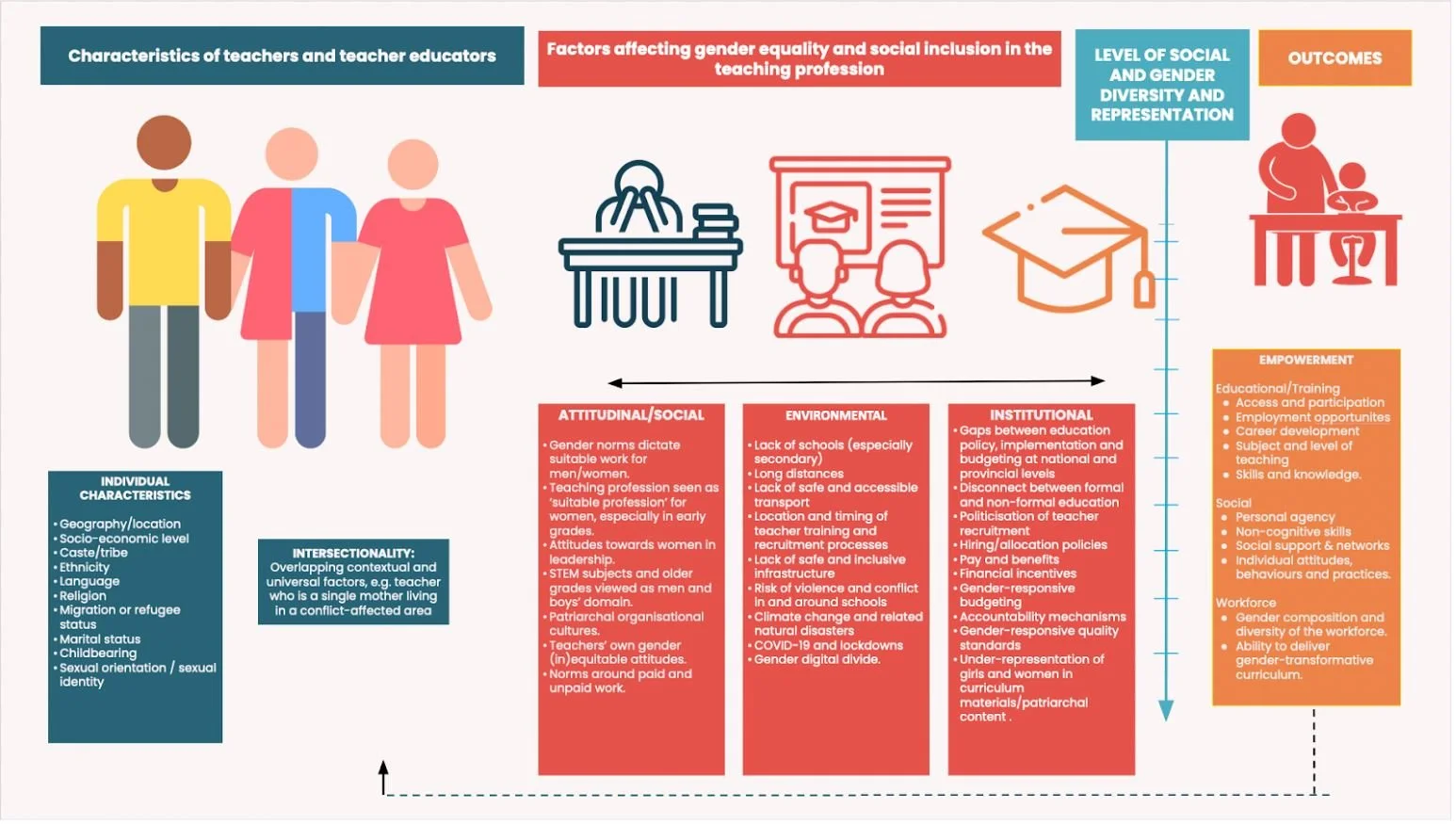
    This rights-based framework was originally designed to encourage analysis of attitudinal, environmental, and institutional barriers to inclusive education. And, importantly, how these barriers overlap and combine to affect girls’ and boys’ educational outcomes depending on their unique individual characteristics, such as gender, age, geography and disability status etc. By adapting the framework to be applied to the teaching profession, we hoped we could shed light on factors affecting the diversity and social inclusion (or lack thereof) within the teaching profession in South Asia, and what the overall outcomes of this are for schools, education programmes and education systems. Figure 1 presents our adapted framework.

    Figure 1: Adapted educational marginalisation framework focused on the teaching profession (Adapted from GEC, 2018)

    Key findings

    Four key findings emerged from our use of this adapted framework: 
    1. The Education Marginalisation Framework can be adapted easily to explore the experience of teachers and teacher educators in different country contexts. It could therefore be used as a useful planning tool, to enable education practitioners to define target groups of teachers and teacher educators and analyse the various barriers which they face both entering and progressing within the profession. 
    2. To create a more diverse and inclusive education system, education programmes, systems and local provision should respond to the barriers at multiple levels faced by different groups of teachers and teacher educators.
    3. Teachers and teacher educators can be powerful actors and allies in the fight against gender inequalities, but they can also perpetuate gender inequality in schools, systems and societies. This highlights the need for focused work with teachers at the attitudinal and social level of the framework. 
    4. While many of the barriers that women and girls face are similar, the ways in which discriminatory gender norms permeate policies, schools, and wider institutions differ across contexts, and are often shaped by the broader social, political and economic fabrics of each South Asian country. 

    By applying the adapted framework, we were able to highlight significant attitudinal, environmental and institutional factors affecting the teaching profession in South Asia. The ways in which these barriers combine to influence individual teachers’ experiences within the profession are closely linked to gender coupled with characteristics such as age, class/caste/ethnicity, socio-economic level, relationship status, geography, disability status and sexuality.

    Across countries, we found that many of the barriers to student access, retention and learning are the same factors holding teachers back from participating and progressing within the teaching profession. For example, environmental barriers including long distances and lack of access to safe transport, conflict, and limited WASH facilities, hinder women teachers’ opportunities, while natural disasters exacerbated by climate change often have a disproportionate impact on women and girls.  Similarly, gender dynamics surrounding access to digital educational resources and online training opportunities hinder teachers’ ability to provide gender-inclusive and quality teaching and learning, a situation exacerbated during the COVID-19 pandemic and subsequent lockdowns. Social and gender norms around women’s mobility, at the extreme, can limit women from engaging in any form of paid employment, and across the board affect women teachers’ ability to participate in centralised and residential teacher training. In the absence of family-friendly policies, including maternity leave and free quality childcare provision, female teachers who are also wives and mothers are unable to leave their homes and domestic responsibilities, causing them to miss out on important professional development and/or leadership opportunities.

    At the same time, discriminatory gender norms shape how teachers, schools and educational institutions treat their students and colleagues, highlighting the need for programmes to engage in individual attitudes and norms of teachers. Gendered perceptions around women as ‘motherly figures’ or the idea that ‘men make better leaders, researchers, scientists, or engineers,’ create an environment in which women make up the majority of the teacher population in the early grades, but then become under-represented at the post-primary grades, STEM subjects, and positions of leadership. Furthermore,  pervasive patriarchal organisational cultures within national education systems can hinder progress, as policy-level decisions are often made without consultation with or participation from women themselves. While underresearched, these male-dominated cultures can lead to risks of sexual harassment and abuse, with teachers having little recourse to report instances of abuse. 

    Our key findings have important implications for those engaged in educational programming and highlight the importance of analysis and action to address gender and inclusion related barriers in the teaching profession. This analysis, and actions grounded in it, are what is needed, to deliver truly gender transformative education. 

    Written by Jenny Holden, Principal Consultant, and Sophia D’Angelo, Associate, Kore Global.

    1. To note, that the Education Marginalisation Framework distinguishes between ‘universal characteristics’ such as age, gender, disability, and ‘contextual characteristics’ such as geography, poverty, childbearing status. For simplification, we had merged these two categories within our adapted framework.
    2. Kore Global worked together with the British Council to develop a Resource Pack for schools on Climate Change and Girls’ Education.
    BACK
    Jan 11, 2022

    Building a feminist, decolonized research approach during COVID: what we learned and unlearned

    In early 2020, a group of researchers from The Asia Foundation and Kore Global began a study of rising inequalities in Asian cities during COVID-19. The aim of our partnership was to develop a collaborative research approach and methodology that would equip country-based teams to take the lead in conceptualising research topics, designing and conducting research that was relevant to particular country and policy contexts. Among the multiple benefits of this approach, it would enable local – predominantly female – voices, experiences and viewpoints to surface. We wanted to localise research design, data collection, and analysis as much as possible, while at the same time strengthening the leadership and ownership of that process by women-led research teams.

    The Research Brief

    In the last 18 months, Kore Global has worked with seven teams in Bangladesh, Laos, Mongolia, Myanmar, Pakistan, Vietnam, and Philippines to build and apply a conceptual framework to understand the multidimensional impact of COVID-19 on marginalized groups living in Asian cities. We began with a multi-module synchronous and asynchronous training on qualitative research methodologies. Then together, we developed localized data collection tools, methods and ethical protocols that could be applied and owned by research teams who were guided by mentors throughout. 

    The COVID-19 Research Challenges

    In the world of research, COVID-19 presents us with an important paradox. On the one hand, the pandemic has deepened economic, social, and political inequalities, which have in turn spurred a desire on the part of governments, civil society, academia, media, and other constituents to understand its multiple impacts as they unfold. On the other hand, it has exposed and shed further light on the inequalities and neo-colonial hierarchies that are reified by traditionally extractive data collection, analysis and communications; the frequently one-dimensional relationship between researcher and research “subjects” this implies; and the power imbalance it ultimately perpetuates and reinforces. This paradox is at once a challenge and an opportunity.

     In February 2021, a group of academics made a powerful statement in the Lancet about power, research and inequality during COVID-19. They argued that the widespread shift to remote data collection “creates ethical and practical concerns that risk perpetuating gender, racial and other inequities. For example, the gender divide in mobile phone ownership, internet access, and digital literacy creates barriers to data collection from women, further silencing their voices and that of other groups without access to these technologies.” In calling for more explicitly feminist and decolonised approaches to research, they identify the potential for power imbalances to be reinforced at every step of the research process from its resourcing through methodology development, through identification of researchers and subjects or sampling techniques, to methods of collection, analysis, communication and beyond.  

    This observation resonates strongly with our experiences in conducting research during the pandemic. It applies to a whole range of methods of data collection and analysis, including and beyond remote data collection, that involve engaging with the perspectives of poor and marginalised populations. Over time, our research process has become an increasingly shared feminist endeavour, as we have sought to better understand, and dismantle unequal power relations within the team and between researchers and research participants. 

     Key Learnings

    1. We have experienced as much a process of unlearning as of learning. For instance, the authors of the Lancet article argue that “the perceived urgency to collect data remotely exposes neo colonial power hierarchies between researchers in affected settings and those in resource-rich settings.” Like many, we started out with the idea we would undertake ‘rapid’ research; yet, ultimately, we resisted this urge, allowing the research to proceed at a pace that worked for local researchers and research participants. The realities of conducting research remotely during a pandemic meant that research teams and mentors were themselves enduring lockdowns and uncertainty around health, family welfare and security. 
    2. By engaging with the challenges that women researchers and women being researched alike were facing and adapting our timelines to fit particular circumstances, we made sure that the experience remained energising and positive for all involved. For example, ensured that ample time and resources were allocated to discuss research ethics and how the data collection process was consensual, safe, beneficial and empowering for research participants.
    3. Having dropped this conventional urgency and accepting the need for a more empathetic and practical approach, we assumed a more considerate pace that strengthened our relationships as a large, multi-country team. The space this afforded also allowed for valuable reflection and adaptation, leading to a host of collaborative learning, exchange and dialogue opportunities – within teams, between teams, between mentors, and between teams and mentors. In addition, we prioritised an empathetic approach, challenging our initial instincts to dive in and ask people as much as we could about their experiences during the pandemic. Checking initial drafts of interview questions by imagining whether questions we posed might trigger distress or discomfort during an ongoing crisis was crucial. At times, deciding to remove questions was difficult, but we prioritized practicality and human understanding over data quantity. 
    4. Key research questions were developed by local researchers, based on consultations with policymakers and community members and literature review, challenging conventional hierarchies in knowledge production grounded in an external gaze. The different issues explored include (inter alia) the impact of school closures on women’s economic participation in the public and private sector in Mongolia; the experiences of ethnic minority migrants in urban areas of Vietnam; and the impact of COVID-19 lockdowns on workers in the tourism industry in Laos. Research teams were engaged from start to finish, through analysis, synthesis and knowledge sharing, not just in data collection. The value of this partnership is abundantly clear in the quality of insights that we are generating, many of which would not have emerged were it not for the deep understanding of local political economies within our research team. As we move through the write-up and dissemination stage, some results of our efforts include narratives of the struggle faced by women entrepreneurs in Bangladesh, the challenges of women balancing paid work and childcare in Mongolia and a cross-country synthesis report. We look forward to publishing a variety of interesting findings such as these in the coming months. Knowledge sharing plans have been developed collaboratively to strengthen the evidence-to-use pathway, and continue to evolve as opportunities arise.  

    Final Thoughts

    With COVID-19 having exposed multiple hierarchies of knowledge, information and power, there is an opportunity to properly dismantle pre-pandemic paradigms of knowledge production between the Global North and South. In seeking to decolonize our own research methods, while using them to expose the gaping inequalities between male, female (and in some cases non-binary) lives in cities in Asia, we hope to contribute to that effort. 

    Respecting and upholding feminist and decolonizing principles is not easy, and adhering to such principles can sometimes be painstaking and inefficient. However, we hope that as a team of researchers committed to advancing more inclusive research methods, our shared journey to more deeply understand the complexities of this commitment will enable us to generate more meaningful and impactful research.

    This article draws on research exploring the varied impacts of COVID-19 on urban inequalities in Asia, funded under a partnership between the Australian Department of Foreign Affairs and Trade and The Asia Foundation, together with Kore Global. The views expressed are those of the authors only and do not necessarily represent those of The Asia Foundation or the Australian Government. We’d like to thank our co-authors, Sally Neville and Mandakini Surie, and our colleagues at TAF, in particular Nicola Nixon, Sumaya Saluja, and the wonderful research teams in Mongolia, Bangladesh, Pakistan, Laos, Myanmar, Philippines, and Vietnam.

    BACK
    Dec 10, 2021

    Kore Global’s 16 days blog series

    Part 3 – How social impact innovators can better address violence against women and girls: practical insights on ethics

    In November 2021, Kore Global undertook a review for Grand Challenges Canada, to help them improve impact measurement for their portfolio of innovations that aim to tackle VAWG. We created a broad theory of change to identify change pathways related to prevention and response of VAWG, developed based on a review of existing ToCs from a range of other organisations. We developed guidance on how to measure VAWG related changes along each pathway, with a focus on quantitative measurement approaches. And we provided guidance on how to plan, conduct and oversee safe and ethical collection of data on VAWG. 

    This blog is part 3 of a 3-part blog series on how social impact innovators can better address VAWG. In each blog, we will share practical insights for impact investors and social impact enterprises that have emerged from a review of evidence on how to address VAWG and measure progress safely and effectively. Part 3, on ethical measurement approaches, provides a practical checklist of considerations to ensure women, girls and researchers are safe when measuring change in each of the 4 impact pathways described in our first and second blogs.

    Collecting any data related to VAWG is inherently sensitive and potentially life-threatening. Any data collection which asks survivors about their experiences of violence, including in order to gather prevalence data, risks retraumatizing women and girls. Even when a decision has been made not to intentionally collect data on experiences or prevalence of violence, it is important to keep in mind that any monitoring and evaluation related to VAWG can still be risky. Discussing topics related to gender equality can unearth deeply entrenched gender norms, potentially threatening power structures, and thus can elicit backlash. As a starting point, we developed a checklist of four key questions to guide practitioners and innovators to ensure a safe and ethical approach to VAWG-related M&E. 

    QUESTION ONE: What is being measured and is there an intention to collect data on prevalence or experiences of VAWG?

    Collection of data on experiences of VAWG is inherently risky. If data collectors do not have highly specialized skills and expertise, this type of data collection has significant potential to retraumatize survivors of violence and also put them at greater risk of future violence. Innovators should: 

    • Refrain from collecting data on experiences of VAWG if teams do not have the necessary skill sets to do so ethically. 
    • Hold in-depth reflections should there be a proposal to collect this data, which should be accompanied by a thorough risk mitigation strategy and a detailed plan that demonstrates that staff have the skills, expertise and resources to do this ethically and safely, including the ability to provide psychosocial first aid and to refer to appropriate support services.
    • Consider other areas of change to measure, such as women’s agency and determine if secondary data sources can be drawn upon.

    QUESTION TWO: Does the proposed team have the appropriate skills and knowledge?

    Given the sensitivity of VAWG and the potential for backlash, monitoring and evaluation activities require data collectors with specialised skills. Innovators should: 

    • Ensure that all members of the team have a strong understanding of VAWG, how to detect distress, psychosocial first aid and a clear commitment to gender equality and violence prevention. 
    • If a disclosure is made, participants should be immediately referred to vetted medical, psychosocial, security and legal services. Ensure M&E teams have a list of services that have been developed based on recommendations from local service providers and women’s rights organizations. Referral pathways should be understood by and made available to M&E teams. If quality services are not available, data collection should not be conducted. 
    • Consider how to bolster protocols and capacities related to confidentiality, safety and security, including the safety of researchers themselves. 
    • Carefully consider gender, ethnicity and languages of team members to ensure they are representative of the participants. 
    • Do not engage in planned M&E activities should it be deemed that M&E teams do not have the required capacity. 

    QUESTION THREE: Could collecting data harm, retraumatize or put participants at risk? What strategies are being used to keep everyone involved in M&E activities safe?

    Collecting data on violence and related areas may trigger participants to relive experiences and can threaten power structures which may result in backlash. Innovators should: 

    • Ask whether data collection could harm or retraumatize participants. If the answer is yes or maybe, innovators should not engage in data collection. 
    • Involve local women’s groups in reviewing the proposed methodology to ensure that it upholds the dignity of women and girls, does not put them at further risk and the information collected will be used to improve both prevention and response.
    • Consider whether data collection methods are safe and necessary and develop a detailed risk mitigation strategy (e.g. use of female interviewers only). Ensure any data collection takes place in a safe place that does not draw attention or raise community suspicions (e.g. consider using women’s health centers or safe spaces where it is routine for groups of women to meet). 
    • Consider how to frame the study. For instance, M&E activities for a VAWG programme could be presented to the community as a study on women’s health and wellbeing, the full details of the study would be explained to the respondent in detail when alone with the interviewer. 
    • Recognise the opportunity costs for participants involved. Given that activities could take time away from engagement in livelihood activities and unpaid care work, and given the particular burden placed on women and girls, tools should not be time intensive. 
    • Make necessary adaptations as the M&E activities progress to ensure the safety protocol is responsive to the needs of all of those involved in activities.
    • As part of escalation protocols, identify a focal point on the team to communicate safety and security issues as they arise.

    We hope you have enjoyed reading this blog series on VAWG impact pathways, measurement approaches and measurement ethics. We would love to hear from any innovators or impact investors about how you have used any of the insights or guidance provided!

    BACK
    Dec 9, 2021

    Kore Global’s 16 days blog series

    Part 2 – How social impact innovators can better address violence against women and girls: practical insights on measurement

    In November 2021, Kore Global undertook a review for Grand Challenges Canada, to help them improve impact measurement for their portfolio of innovations that aim to tackle VAWG. We created a broad theory of change to identify change pathways related to prevention and response of VAWG, developed based on a review of existing ToCs from a range of other organisations. We developed guidance on how to measure VAWG related changes along each pathway, with a focus on quantitative measurement approaches. And we provided guidance on how to plan, conduct and oversee safe and ethical collection of data on VAWG. 

    This blog is part 2 of a 3-part blog series on how social impact innovators can better address VAWG. In each blog, we will share practical insights for impact investors and social impact enterprises that have emerged from a review of evidence on how to address VAWG and measure progress safely and effectively. Part 2, on measuring change, highlights 2 risks and measurement tools for each of the 4 change pathways described in our first blog.

    Innovators who seek to measure change related to prevention of VAWG should focus on measuring changes in women’s and girls’ agency, men’s and boys’ attitudes and behaviours, community attitudes and norms, and the use and quality of services. It is unlikely that they can ethically collect data on prevalence of violence. 

    There are two risks associated with measuring prevalence. 

    Risk 1: Collecting prevalence data on VAWG – and in fact any data collection with survivors – requires expert skills. Specialist training and specific protocols are required. In the absence of these, use of any measurement tools, including those outlined below can risk retraumatizing participants and can cause further harm. As an alternative, it is often more appropriate to consider measuring other forms of short and medium-term outcome level changes, as described above. 

    Risk 2: Using prevalence data can be problematic. Datasets that are generated by measures of the experience and perpetration of violence both suffer from severe underreporting. This can make interpretation of the data very difficult, particularly if measures are being used to track change over time. For example, data which shows an increase in women experiencing violent behaviours may reflect an actual increase violence. However, the same data may actually be indicating that women are feeling better able to acknowledge and speak about the violence they have experienced. Nonetheless, secondary data from long term studies (such as the DHS) can be useful for long term trend analysis. 

    There are a number of good quantitative data collection tools that can be used to measure short and medium-term changes along the four different impact pathways. Here are a few we would like to highlight.

    Women’s agency: Northwestern University, QualAnalytics and Harvard University have developed a short five-question validated survey module for women’s agency. The survey instrument was developed for use with married mothers in Northern India and although context-specific, could have broader application elsewhere, particularly with some tailoring. 

    Men’s attitudes and behaviours: A measurement tool which is designed to capture gender equitable attitudes more broadly (including gendered roles and responsibilities) is the Gender Equitable Men (GEM) Scale. The GEM Scale was developed by the Population Council/Horizons and Instituto Promundo through qualitative research with men in Brazil . Testing then led to the identification of a scale which could be used to identify the extent to which men agreed or disagreed with these beliefs. 

    The International Center for Research on Women (ICRW) and Instituto Promundo drew on the GEM scale to develop a measurement tool, the International Men and Gender Equality Survey (IMAGES). This is an extensive household survey which captures a broad range of information on men’s attitudes and practices in relation to gender equality, as well as women’s perspectives on these. Like the GEM tool, the IMAGES survey has been adapted and used in a range of contexts.

    Community attitudes and norms: Some measurement tools focus specifically on attitudes towards sexual violence and the extent to which victims and survivors are blamed for the violence they experience. The most well established and tested of these is the Illinois Rape Myth Acceptance Scale (IRMA). This tool includes a list of statements which aim to understand people’s attitudes towards rape, with a focus on understanding foundational beliefs.

    Care Sri Lanka has developed, piloted and used a survey to capture change in relation to the ReNEW Project (Redefining Norms to Empower Women). This measurement tool was designed to measure shifts in gender-equal norms relating to masculinity and IPV among communities in Sri Lanka’s tea plantations. Importantly, the tool can be used not only to capture a ‘snapshot’ of norms at a particular moment in time, but to track the strength of influence these norms have over time.

    Use and quality of services: The DHS Domestic Violence Module and the WHO multi-country study on women’s health and domestic violence both include survey questions which seek to generate data on help-seeking behaviours among survivors. Beyond reporting and access to services, measurement tools can also be used to capture how effective and safe services are in terms of how they handle and follow up with reports. Here, measures can focus on survivors’ own perspectives in terms of their satisfaction with the quality and safety of VAW services. However, these types of measures can be affected by some of the same challenges as those which capture prevalence data and require the use of researchers with specialist skills in the same way.

    An alternative is to collect data from service providers, seeking their views on the support they are providing, both in terms of reach and effectiveness. The Ontario Violence Against Women Service Provider Survey is designed to capture the perceived impact of a range of different services and the challenges they face in meeting the needs of a diverse range of survivors. The survey tool has been used to identify gaps in services and the effectiveness of coordination between services in terms of meeting survivors’ needs.

    Watch out for our next blog, which we will release tomorrow, that focuses on how to measure changes in VAWG in a safe and ethical way.


    BACK
    Dec 8, 2021

    Kore Global’s 16 days blog series

    Part 1 – How social impact innovators can address VAWG: practical insights on impact pathways

    In November 2021, Kore Global undertook a review for Grand Challenges Canada, to help improve impact measurement for their portfolio of innovations that aim to tackle violence against women and girls (VAWG). We created a broad theory of change to identify change pathways related to prevention and response of VAWG, developed based on a review of existing ToCs from a range of other organisations. We developed guidance on how to measure VAWG related changes along each pathway, with a focus on quantitative measurement approaches. And we provided guidance on how to plan, conduct and oversee safe and ethical collection of data on VAWG. 

    This blog is part 1 of a 3-part blog series on how social impact innovators can better address VAWG. In each blog, we will share practical insights for impact investors and social impact enterprises that have emerged from a review of evidence on how to address VAWG and measure progress safely and effectively. Part 1 focuses on what we have learned about impact pathways; it presents 3 key insights and describes 4 main impact pathways.

    Insight 1: There is a two-way relationship between VAWG and gender inequality, with VAWG being rooted in – and fuelled by – gender inequality, patriarchal norms and gendered power relations. At the same time, gender inequality is held in place by the perpetration and fear of VAWG.  

    Insight 2: Understanding change in relation to VAWG requires understanding the multiple and intersecting forms of discrimination and marginalization that compound risk for some women and girls and result in varied experiences of violence.

    Insight 3: Effective prevention of and response to violence is achieved through four interconnected pathways, focusing on: 1) women and girls; 2) men and boys; 3) communities and families; and 4) services and institutions. While the first and fourth of these pathways are often emphasized in terms of prevention and response, the second and third are critical for addressing VAWG as a product of and a contributor to gender inequality. 

    Let’s look at each of these four pathways in turn. 

    Women and girls: as a result of interventions, we expect to see short-term changes in knowledge and understanding of what constitutes VAWG, as well as how to access services, how to report and how to access social and economic assets. These changes are expected to result in women and girls to be empowered to express their equal worth, autonomy and agency across all areas of their lives, including within their intimate relationships, families, households, workplaces and wider communities. 

    Men and boys: short-term changes as a result of interventions focus on underlying masculinities and attitudes towards violence, perceived equality of women and girls, sexual consent and understanding of how societal expectations of how men ‘should’ behave are detrimental to themselves as well as women and girls. In the medium-term, this results in men and boys demonstrating greater emotional awareness and resilience, and expressing themselves in ways that are non-violent. 

    Family and community: expected short-term outcomes as a result of interventions focus on the pervasive attitudes that result in VAWG being tolerated. Outcomes focus on building knowledge and capacity of community groups to strengthen their role in ending VAWG, as well as shifting attitudes and understandings of masculinities, bodily autonomy and what constitutes VAWG. In the medium term, these changes are expected to result in relatives, friends, colleagues and wider community members becoming active allies in promoting gender equality and ending VAWG, intervening when they witness violence or threatening behaviour and actively demonstrating a lack of tolerance for violence, including the use of social sanctions for perpetrators. 

    Services and institutions: in the short term, change is expected in fostering political and institutional will and commitment and building the capacities of service providers and decision makers to deliver responsive services to women and girls. Furthermore, it is expected that the capacity of women’s rights organizations will be strengthened in order to hold decision makers accountable. In the medium term , these changes are expected to result in survivor-centred reporting mechanisms and support services (medical, safety, legal, psychosocial, livelihoods) that are well resourced, accessible and consistently delivered to safely meet survivors’ needs. Alongside this, justice systems operate appropriately and effectively to punish perpetrators of VAWG and act as a deterrent to others. 

    We have a beautiful visual of this ToC that includes more details, so if you are interested please do reach out to us and we will send it to you!

    Watch out for our next blog, which we will release tomorrow, that focuses on measuring change along these four pathways.