
BACK
Dec 10, 2023

Towards a new – more feminist – approach to partnership brokering

Written by: Katherine Nichol, Principal Consultant, Kore Global.

To support the commitment of the Australian Department of Foreign Affairs and Trade (DFAT) to accelerate efforts to prevent gender-based violence (GBV), Kore Global was engaged to lead a co-design process for a major new gender equality investment – the Southeast Asia GBV Prevention Platform. The design process was highly collaborative, spearheaded by a core design team of key organizations working on GBV and informed by a rigorous mixed-method consultation process with 160 stakeholders across 10 countries in the region. To end the 16 Days of Activism against Gender-Based Violence, we have summarized a few of our learnings on partnership brokering from this GBV project.

Kore Global was presented with a very important – and very challenging – task: coordinating diverse actors to design an inclusive platform that addresses a complex social issue. Our role was to facilitate and broker partnerships and, ultimately, design a platform that reflects the varied needs and interests of these stakeholder groups. 

What became clear throughout the co-design process was the need to take a different and distinctly feminist approach to partnerships. Traditional approaches to partnership brokering have often replicated systems of power and inequality. These are the very systems of inequality that the GBV sector works to dismantle. 

It is against this background that Kore Global is incubating a new – more feminist – approach to partnership brokering. Through our work with DFAT and other clients, we have identified key building blocks that are critical in creating more equitable partnerships. We highlight a few of these below.

1. Co-design feminist partnership principles and behaviours 

We kick-off our partnership processes by agreeing a set of feminist principles. These principles are identified by the individuals engaged in the process, thus facilitating ownership and buy-in. They can range from principles of inclusion, decolonization, survivor-centered and self-care, among others. Equally important is bringing these principles to life, by generating a list of behaviours that reflect the principles. This is particularly important in diverse and cross-cultural settings, as principles might be understood in different ways, and by digging into behaviours, we are able to explore different and more inclusive and empowering ways to express – and live – our shared principles. We have found this process to be truly transformative as it promotes accountability for the partners involved (including ourselves) and provides a filter through which partners can make critical design decisions. 

2. Create spaces for deep listening 

Design processes can often be fast-paced, with participants forced to rush to decisions to meet ambitious timelines. Given the complexity of working on GBV (as well as other gender equality and social inclusion topics), we consciously create spaces to pause, listen and reflect (we discuss this more below). This is not always easy, but it is absolutely essential. Understanding that participants prefer to learn and share in different ways – from one-to-one conversations to large workshops – we ensure that the spaces we create meet participants’ needs, so that all partners can truly understand and reflect on their inputs. Trust is fundamental to fostering a safe space, something that takes time to build throughout the partnership process, but we’ve found that developing a set of feminist principles and behaviours – and revisiting these regularly – is an essential foundation for this. 

3. Identify processes to promote collaborative decision-making 

Work on GBV aims to challenge traditional systems of power. Therefore, partnership processes should also explore new ways of decision-making that replace more hierarchical approaches. We have worked with teams to jointly identify decision-making protocols that promote transparency and collaboration as much as possible. We often encourage distributed leadership approaches, a decision-making structure that promotes teamwork and interconnectivity. At a minimum, we start our design processes by bringing together teams to create a shared understanding of how decisions are made. 

4. Ensure accountability through feminist partnership pauses 

A ‘feminist pause’ is a key moment that we weave throughout our partnership brokering processes. A feminist pause is an opportunity for participants to revisit the feminist partnership principles and reflect on how they are – or aren’t – being upheld. It can be created using a number of different tools and methods, tailored to the design process; this ranges from online platforms where partners can leave anonymous thoughts to participatory reflection workshops. Partnership processes need to be agile with the opportunity for adaptation based on feedback surfaced through feminist pauses. 
BACK
Nov 25, 2023

Five reasons why climate change exacerbates gender-based violence

Written by: Katherine Nichol, Principal Consultant, Kore Global.

It is commonly acknowledged that climate change is the foremost existential threat of our time. Even with increased attention to climate justice, the intersections between climate change and gender-based violence (GBV) are often unexplored. This is despite the fact that there is growing evidence to suggest that climate change and environmental degradation increase the risks of GBV, including trafficking and child early and forced marriage (CEFM). For example, in the aftermath of Typhoon Pablo in the Philippines, a quarter of women aged 18-24 reported experiencing intimate partner violence, and violence increased three-fold in the aftermath of the 2004 Indian Ocean Tsunami. With the escalating frequency and severity of climate-related disasters and the associated impacts of migration, climate change has firmly become a feminist issue. 

At Kore Global, we have increasingly brought a climate justice lens to the work we do on gender equality and specifically on GBV. Through these targeted efforts, we have gained a better understanding of how and ultimately, why climate change and GBV are deeply interconnected. 

As the 16 Days of Activism against Gender-Based Violence begins, we have summarized a few of the insights from our work below to contribute to the discussion of this important intersection and catalyze joint action.

1. Climate related-disasters can increase risk factors 

Conditions associated with both slow-onset and acute disasters can intensify the risk factors that fuel GBV. Women and girls are often responsible for the collection of food, water and firewood. Drought can leave women more vulnerable to violence as they have to make longer – and sometimes more dangerous – journeys. Research in Uganda found that in drought settings there is increased sexual exploitation in exchange for the purchase of food or to pay rent. Furthermore, in migration settings, shelters can leave women and minority gender groups with greater physical and privacy-related risks, with women particularly vulnerable to violence when sleeping, washing or bathing. 

2. Climate related-disasters can disrupt essential services

Climate-related disasters often result in migration and the disruption of essential services that are critical to GBV response efforts. These essential services – ranging from healthcare, psychosocial support, social, and legal and justice services – are often under-resourced or suspended during acute disasters. This often happens in the context of heightened demand for such services. For instance, in the aftermath of Hurricane Maria in Puerto Rico, there was a 62 percent increase in requests for violence survivor-related services

3. Climate related-disasters can deteriorate social support structures

Much like the disruption to essential services, acute disasters and migration often undermine traditional support structures, such as family connections and relationships with community leaders. As a result, social isolation can leave individuals more vulnerable to violence. 

4. Climate related-disasters can increase rates of child, early and forced marriage 

When families cannot meet basic needs, the risks of child, early and forced marriage increase. New research from Save the Children indicates that two-thirds of child marriages happen in regions with higher-than-average climate risks. Furthermore, they estimate that the number of girls at risk of child marriage will increase by over 30% to nearly 40 million by 2050. 

5. Climate related-disasters can result in more rigid and discriminatory gender norms

The root cause of GBV is gender inequality. There is a significant body of literature to suggest that emergencies increase household stresses, change power dynamics and challenge dominant gender roles (such as men experiencing unemployment). This can result in increasingly discriminatory gender attitudes and practices, ultimately fueling gender inequality. 

So what can be done? While the relationship between GBV and climate change is well established in the literature, there remains a limited – although growing – evidence base on climate-informed GBV interventions and approaches. What is clear is that a holistic approach is necessary; this includes cross-sectoral partnerships and cooperation at all levels and greater integration of gender equality and GBV into broader humanitarian processes (such as disaster preparedness and humanitarian response plans). Climate change is a feminist issue and, as such, women’s rights organizations and women environmental human rights defenders must be central to response efforts. 

BACK
Nov 20, 2023

Top tips for designing a gender equality strategy

Written by: Dharini Bhuvanendra, Consultant, Kore Global.

Kore Global provides long-term gender equality advisory support to Grand Challenges Canada (GCC). As part of this ongoing support, and in line with GCC’s commitments to gender equality, Kore Global facilitated a participatory training for staff on the topic of developing gender equality strategies. The focus was on how best to support GCC investees, innovators in the health and humanitarian sectors, to adopt a gender and inclusion lens across all aspects of their work. GCC requires innovators to develop a gender strategy when their innovation is approved for further funding and scaled up, in order to identify and track key gender commitments at both programmatic and organizational levels, with the overall aim of contributing to the achievement of gender equality. Kore Global acts as an advisor to innovators on their gender strategies, providing tailor-made support and advice that is right-sized to the innovation. 

A gender strategy outlines an organization’s overall approach to gender equality and inclusion and provides a framework to define and implement measurable and trackable goals and actions. It also formally articulates an organization’s commitment to achieving gender equality outcomes and builds in accountabilities by assigning responsibilities to people within the organization. The process of designing a gender strategy can be catalytic for an organization, giving individuals the opportunity to think about and discuss gender and inclusion and beginning a process of integrating gender equality into the organizational culture. 

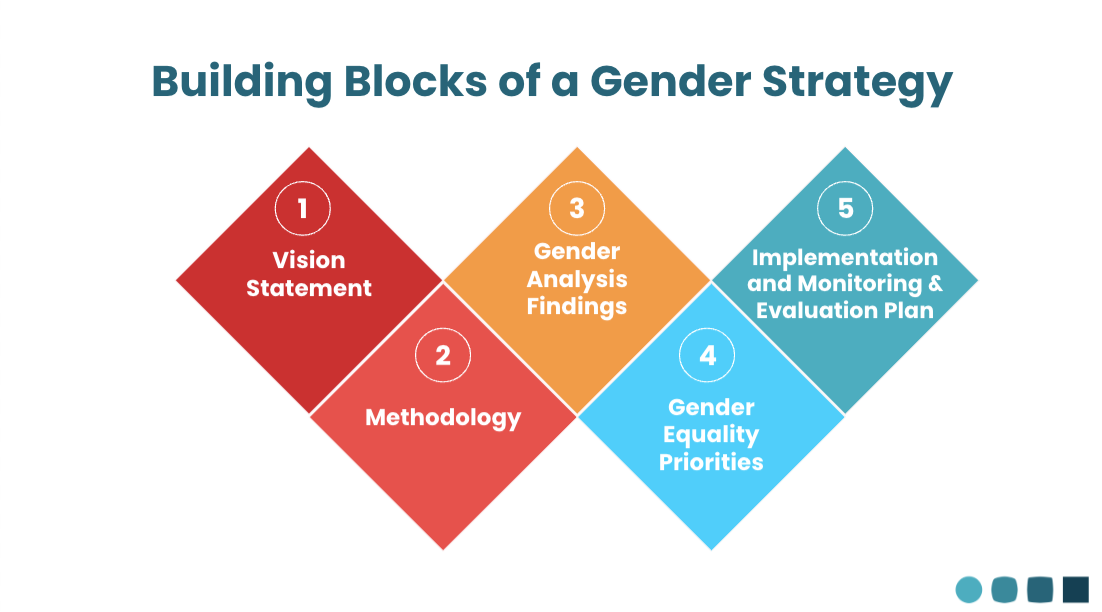
Through this support to over 30 GCC-funded innovators, Kore Global has learned a lot about what works best for gender strategy development. Broadly, we recommend that a gender strategy is based on five key building blocks which are: Vision Statement; Methodology; Gender Analysis Findings; Gender Equality Priorities; and Implementation and Monitoring & Evaluation Plan.

Here are some top tips on designing gender strategies based on Kore Global’s experience with GCC-funded innovators:

  • The gender strategy should be right-sized to the organization. Different organizations are at different stages of their gender equality journeys and the strategy should provide the organization with clear, realistic goals. It is not always necessary to add new initiatives to what an organization is already doing; bringing a gender lens to existing activities can be a starting point. 
  • The methodology for the gender strategy should be based on organizational capacity. The methodology can range from a simple, lighter-touch approach where for instance a gender focal point takes the responsibility for designing the strategy and presenting it to the organization. A more participatory and higher-touch approach could involve staff surveys, community consultations and focus groups, as well as desk research on key gender issues. This approach is more transformative but can also be time-consuming and requires resources that not all organizations have.
  • A gender analysis is at the heart of a gender strategy, as it identifies the specific barriers, challenges and opportunities faced by individuals with different gender identities in a particular context. The analysis should be relevant to the intervention the organization is implementing but also consider the wider socioeconomic and political context. An intersectional analysis will consider multiple, overlapping and intersecting identities for a more nuanced understanding of exclusion and marginalization. 
  • The strategy must have an implementation and monitoring and evaluation plan with clear, measurable and time-bound actions that give the organization something to aim for within a particular program or funding cycle. This helps avoid the risk of gender priorities being postponed or forgotten. 
  • Accountabilities must be in place including how and when the strategy will be reviewed and reported on and who is accountable for its implementation in senior management. This ensures that gender and inclusion work is prioritized within the organization. 
  • The organization must have the adequate capacity and resources to achieve its gender equality priorities. This is why it’s so important to make sure the strategy is realistic and right-sized. The organization can then identify any resource gaps that can be filled either internally or externally. 
BACK
Nov 9, 2023

Navigating economic empowerment and sexual and reproductive health for adolescent girls

Written by: Meghan Cutherell, Senior Program Manager, A360 and Katherine Nichol, Principal Consultant, Strategy Team Lead, Kore Global

Navigating the ‘how’ of pursuing both improved economic power and sexual and reproductive health in holistic programming for adolescent girls

The 2023 Women Deliver Conference convened more than 6,000 global leaders, advocates, and experts to discuss and advance gender equality and sexual and reproductive health and rights at scale. During the event, PSI’s Adolescents 360 (A360) program hosted a panel of experts for a candid dialogue on a persistent challenge in the field of adolescent girls’ programming: how to effectively support both girls’ economic power and sexual and reproductive health (SRH) through holistic programming. While a robust body of evidence acknowledges the multifaceted and intersecting challenges faced by adolescent girls, along with the need for holistic program models, there remains limited evidence on how to successfully integrate SRH and economic empowerment program components. The sector knows why integrated programs are important but are left with a need for practical tips and tools on the how.

To tackle this question, PSI’s Adolescents 360 (A360) program turned to five leading experts on adolescent girls programming. The panel at the 2023 Women Deliver Conference included Karen Austrian from the Population Council, Rudo Kayombo from BRAC, Alice Odhiambo from Population Services Kenya, Greta Bull from the Bill and Melinda Gates Foundation, and Fifi Ogbondeminu from Population Services International.

Read below for our five takeaways from the event.

1. Center girls’ voices and experiences

Karen Austrian noted that while there is a well-established evidence base on what works for integrated SRHR and economic programming for women, programs shouldn’t assume that applying this evidence for girls is just a ‘copy/paste’ exercise. Girls and young women’s experiences are unique to their specific life stages. A lifecycle approach – which contextualizes program models to respond to their evolving needs – is crucial to ensure programs deliver the right approaches at the right time.

The A360 project’s experience demonstrates the utility of human-centered design (HCD) – an approach that encourages rapid iteration based on real-time, direct user feedback – as a powerful tool to center girls’ voices and align with girls’ stated needs and preferences. HCD can validate, clarify, and refine the evidence base, ensuring that what works for one population is effectively contextualized to another.

2. Acknowledge the influential role of girls’ ecosystems 

Girls live in complex ecosystems, comprised of various influential actors such as family, peers, communities, and  government. To design holistic solutions to girls’ interconnected challenges, project implementers must engage with these diverse stakeholders.

Integrating girl-centered programming into government systems can help make them more sustainable, but the needs of adolescent girls are too often buried beneath the competing priorities of government actors. Fifi Ogbondeminu, A360’s Global Program Director, suggests the following approach to overcome these challenges: “identify the problem you are working to solve and frame it as a problem [the government] also wants to address.” A360 is working to marry the interests of government health agendas with the needs of adolescent girls to build stronger, more holistic girl-centered programming.

3. Use messaging around goals and aspirations as an entry point to establish the relevance of contraceptive use

SRHR programs benefit from the inclusion of economic empowerment content for a number of reasons. In the process of supporting girls to identify their goals, programs are presented with the opportunity to offer the resources needed to achieve those goals, including contraception as a means to prevent an unplanned pregnancy. This aspirational approach, that presents contraception use as a means to reach girls’ goals, is often more compelling than traditional SRHR approaches that try to use sexual activity as a means of establishing the importance of contraceptive use.

Additionally, given the sensitive nature of SRHR topics, layering content around goal setting and skills building can be an entry point for gaining the buy-in of girls and their families or partners for their participation in SRHR programming. The panel emphasized the importance of mitigating any potential risks that would come from ‘flying too far under the radar’ with the SRHR program content.

For example, in A360’s initial phase, we found that our messaging was not direct enough about the services we offered for girls and the SRHR component of our program, creating confusion and hostility among some users and harming the impact of the program.

4. Test, pilot, refine and scale

Holistic program models are often criticized for being too expensive and too complex. In order to mitigate these challenges, experts promote the idea of starting small, identifying what works and scaling. This is the foundation of the approach adopted by BRAC, whose Ultra-Poor Graduation (UPG) model represents one example. The program is a comprehensive and sequenced set of interventions to promote sustainable livelihoods and socioeconomic resilience using several elements such as hands-on coaching, enterprise development training, community mobilization and access to healthcare services.

Given that it is a complex program model, it is critical to make a long-term investment and build adaptability into the initial design.

5. Address the root causes

The root causes of girls’ lack of economic empowerment and SRHR are the same: inequitable gender norms and limited agency. When combining SRHR and EE programming, both approaches should actively enhance girls’ power and agency. Working at the household, community and government levels is particularly necessary in transforming gender norms; this includes working with men and boys as well as parents.

As the sector refines its approach to holistic programs for adolescent girls, these five tips provide a starting point to more intentionally integrate economic empowerment and SRHR program elements.

BACK
Oct 30, 2023

Recognising and rewarding care: a game changer for paid care and domestic workers

Addressing the social and economic injustice that is embedded within wider capitalist systems of care is a complex challenge and requires an ecosystem of actors working together. The recent UN General Assembly resolution that proclaimed an International Day of Care and Support on 29 October is groundbreaking for a number of reasons.

It is groundbreaking because it recognises the pivotal role played by a range of ecosystem actors, including worker and employer organizations, women’s and community-based organizations, feminist groups and youth organizations. It calls on Member States, the UN system, civil society, the private sector, academia and the public to observe the day annually.    

It is groundbreaking because it recognises that this injustice is intersectional in nature and that care is a fundamental human right, a right that is not only important for women’s economic autonomy, but for the overall well-being of both care workers and the communities that they serve. Care for our families and our communities largely rests on the shoulders of women, poor women. And those who so often need care the most – the aged, people with mental and physical disabilities, children from disadvantaged households – are the least likely to be able to access it. Volker TÜrk, the UN High Commissioner for Human Rights stressed that “in marking the 75th anniversary of the Universal Declaration of Human Rights, I called upon States to take concrete steps towards establishing support and care systems that are human rights-based, gender-responsive, disability-inclusive, and age sensitive.”

Kore Global’s care economy research over the past two years – in partnership with CoreWoman, Intellecap, Busara and Sagana and with support from IDRC and SEDF – has deepened our understanding of how transformational the recognition and reward of paid care work can be in the lives of female care workers. It goes far beyond economic empowerment and reveals the much wider and deeper value that women gain when their work is adequately recognised and rewarded through, for example, the provision of formal employment, flexible and part-time working, access to social security benefits (that, depending on the country, could include access to public healthcare services, sick leave, maternity leave, disability pension, retirement fund, and public daycare allowance), travel allowances, skills building and educational opportunities, monthly bonuses, housing subsidies, and financial inclusion.

We asked women who work as paid care and domestic workers in Latin America for companies, such as Homely, Symplifica, Hogaru and Best Care, what positive changes this recognition and reward have brought to their lives. 

They emphasized increased rest and calm consistently.

“There has been a positive change in my life because I have been relaxed and calm. I do my job to the best of my ability, and I feel understood by both my bosses – the client and Homely.” Care worker, Homely, 50+ years old. 

“Since I have joined Homely, I have less fatigue. I have more free time that I use to rest.”  Care worker, Homely, 37 years old. 

“I have had much more peace of mind; I don’t stress so much…I have time to eat, to rest. It is calmer.” Care worker, Best Care, 22 years old.

They highlighted their increased ability to connect with their children, wider families and communities.

“I tell you, for me, my priority is my children and I would never exchange time with them for earning a little more, because what good is it for me to fill them with material things without my time?” Care worker, Hogaru, 34 years old.

They spoke about their ability to save, plan for the future, and achieve economic independence.

“Yes, today thank God, my life has changed positively, I also have my own income. I am not waiting for my partner to suddenly give me my personal things. I also have my con qué hablar [economic Independence].” Care worker, Hogaru, 42 years old.

“I couldn’t make decisions, I had to wait for my sister to send me money to pay the rent and now I don’t, I am the one who pays for everything in my home, I am the one who decides.” Care worker, Hogaru, 36 years old.

They valued their newfound self-esteem and confidence. 

“They know how to value the worker, not just because she is a maid; no, they treat you the same as any other person.” Care Worker, Symplifica, 53 years old.

“Best Care has helped me a lot. They have helped me a lot with studying as a nursing technician and my current career is full of development. I like to speak up and have some confidence now when speaking to others.” Care worker, Best Care, 46 years old.

While the UN resolution talks about improving policies and scaling up investments to strengthen economies and increase development – which is critical – it is also important to understand that recognising and rewarding women’s care work is a deep structural and normative shift that goes far beyond policies and investments. It is about recognising women’s fundamental rights to rest, to nurture and be nurtured by their families and communities, to feel secure, to feel enough. That is what women value.

Read more about our work on the Care Economy Knowledge Hub. Between November 2023 and February 2024 we will be publishing 20 care economy business case studies that include a deep dive into care business models and into the impacts of these businesses on women’s lives. Please reach out to contact@koreglobal.org if you are interested in learning more about this research.

BACK
Oct 11, 2023

International Day of The Girl 2023 

Written by: Becky Zelikson, Analyst, Kore Global.

Celebrating grassroots organisations that are centering diverse adolescent girls in their education and empowerment projects

Girls around the world continue to experience barriers to their education, physical and mental wellness, and realizing their rights to a life free of violence. On this International Day of the Girl 2023, Kore Global would like to acknowledge and celebrate grassroots champions of adolescent girls’ education and empowerment, which we have been fortunate to get to know during our recent project with the Obama Foundation’s Girls Opportunity Alliance (GOA). 

As part of our engagement with GOA as their Learning and Evaluation partner, we spoke in depth with 14 of GOA’s grassroots grantees and invited some of them to present as part of our capacity-strengthening learning sprint, attended by the broader GOA Network of grassroots leaders. We were incredibly impressed with their commitment to using girl-led and participatory methods, involving girls in activities ranging from design to implementation to monitoring and evaluation data collection, analysis, and presentation. Girl-led approaches of this kind not only help participating girls build leadership and research skills, but also ensure that the programming and MEL activities are sensitive to diverse adolescent girls’ needs, and truly respect and promote adolescent girls’ agency and ability to shape their own lives. 

The three organisations presented below are driven by a passion for girls’ rights, are informed by the priorities of the adolescent girls they work with and serve, and continue to challenge and address the social, political, economic, and cultural barriers standing between adolescent girls and the lives they wish to lead.

Samburu Girls Foundation

Samburu Girls Foundation (SGF) is a Kenyan NGO which rescues girls from child marriage, beading and FGM. SGF has rescued 1183 girls thus far and 326 are currently being sponsored in schools around the country. SGF offers rescued girls a safe place to live and study, and psychosocial support. In addition, they facilitate community dialogue and mediate between rescued girls and their families to promote reconciliation and return girls to their homes, once their families show a commitment to refraining from the harmful practices from which the girls were rescued and are supportive of their girls’ continued education. 

Crucially, the foundation doesn’t stop at rescue and reintegration; it actively encourages girls to take the lead in shaping SGF’s programmes. SGF’s Girls’ Council program exemplifies this commitment, encouraging girls to assume leadership roles that mirror Kenya’s governance structure. These girl representatives engage in meaningful dialogues with the management of their boarding schools, addressing concerns and advocating for improvements identified by their fellow students. Additionally, the foundation’s journalism club empowers girls to express themselves through photography and storytelling, fostering self-reflection, empowerment, and effective communication. These initiatives ensure that girls’ voices are not only heard but also valued and respected, emphasizing their agency in influencing and enhancing their own educational experiences.

Milaan Foundation

Milaan Foundation is an Indian non-profit, social impact organisation working with and for adolescent girls and young women to impart knowledge and skills, and provide the social environment needed to pursue their aspirations. They work closely with communities to challenge social norms that reinforce gender inequality and normalise social, economic, and political exclusion.

Their flagship program, the Girl Icon Program, is dedicated to harnessing the leadership potential of girls, recognising the unique challenges they face within their communities. Key to this approach is providing girls with comprehensive training and actively involving them in programme development and Monitoring, Evaluation, and Learning (MEL) processes.

Selected Girl Icons undergo leadership training and become central to the programme’s decision-making and implementation. They design social action projects and facilitate MEL processes by capturing monitoring data through a custom smartphone application. Each Girl Icon mobilises an additional 20 girls in her community, thus exponentially expanding the reach of Milaan’s programming. Thus far, 16,000 girls and 160,000 community members have been reached, and 80% of Milaan Foundation’s staff are alumni of the programme.

Milaan’s commitment to girl-centred empowerment is also evident through their advisory council of girls, ensuring their voices guide the programme’s evolution in a changing landscape. It’s a model of empowerment where girls take the lead in formulating their destinies and driving change in their communities. 

Girl MOVE Academy

Girl MOVE Academy is a Mozambican leadership academy that promotes older adolescent girls and young women’s education and leadership through an intergenerational mentoring model. Grounded in a belief in the inner power of each girl and woman to lead and become a changemaker, they train and promote Female Reference Models who facilitate Sisterhood Circles that bring about positive change in the community and multiply the reach and impact of Girl MOVE Academy’s initiative. 

Every year, Girl MOVE Academy recruits 40 women graduates, 120 women college students and 1200 young girls. By pairing 1 woman graduate and 4 college students, the five mentors become responsible for mentoring 30 young girls as their big sisters, sharpening their literacy and numeracy skills, and educating them on the Sustainable Development Goals. 

The 160 girl mentors participate in the ongoing evaluation of the programme after each trimester and take part in devising strategies for improvement and addressing challenges. The programme has reached over 15,000 girls and women and has recently been recognised by UNESCO as an exemplary girls’ and women’s education programme. 

These three outstanding organisations help re-affirm and illustrate the agency and power of girls to speak out about the problems and challenges in their lives and in their communities, devise effective strategies for addressing them, and mobilise their peers in social movements that promote girls’ education and ultimately their empowerment.  


We encourage you to support these efforts by donating to Samburu Girls Foundation, Milaan Foundation, and becoming a partner/impact investor in Girl MOVE Academy. You can find out about and support more grassroots projects working on similar issues on the Girls Opportunity Alliance’s GoFundMe page.


Happy International Day of the Girl!

BACK
Oct 5, 2023

Unveiling the Realities of Women’s Economic Empowerment in Sub-Saharan Africa

In 2022, Kore Global and Euromonitor International embarked on a journey to shed light on an often-overlooked aspect of economic development: women’s economic empowerment (WEE) in Sub-Saharan Africa. The overall aim of the “Pathways to Inclusive Economic Growth” study was to explore the challenges and opportunities faced by women in the region, and to provide recommendations for key stakeholders looking to break down barriers to WEE. Drawing upon a wealth of secondary research, the partnership produced 13 comprehensive country reports, delving into 19 sectors across Sub-Saharan Africa. 

As the dust settles on this ambitious project, we wanted to share just a few of our main takeaways from this landmark research initiative.

1. Unpaid Care and Domestic Work: One of the biggest constraints to women’s (paid) work 

One resounding finding was the profound impact of unpaid care and domestic work on women’s economic engagement. Across sectors and countries, women bear the brunt of unpaid care and domestic responsibilities, often in addition to unpaid labour like food production on land they don’t own. The stark reality? Women spend 2-4 times more time on unpaid work than men. However, in many countries and contexts, women’s unpaid care work is often hidden, absent from national data sets, research agendas and economic and sectoral analysis. This invisible responsibility serves as a significant constraint to women’s participation in and benefit from paid work. The first step toward change is recognising this hidden work, making it visible, and counting it.

2. Rethinking the Paid vs. Unpaid Work Divide

Traditional notions of paid versus unpaid work fail to capture the complex reality for most women in Sub-Saharan Africa. They often straddle both categories simultaneously, blurring the lines. Gender plays a pivotal role in defining both the nature of women’s labour, but also whether they are paid. For instance, women’s contributions to sectors like Uganda’s coffee industry and Tanzania’s livestock farming – unlike men’s – often go unpaid, hindering their economic progress. Furthermore, in many rural areas across the region, women are compelled to provide unpaid labour on their husbands’ plots before tending to their own economic activities. The quest for flexibility to manage caregiving duties further pushes women into underpaid and unregulated sectors. This striking gender inequality needs to be called out and directly challenged if women are to be given anywhere near a level playing field. 

3. Gender-Based Violence: A Crippling Barrier

The persistence of high levels of gender-based violence (GBV) is a major obstacle to women’s economic empowerment. Approximately one-third of women in the region experience intimate-partner violence, upwards to 38% in Angola, 39% in Cameroon, and 45% in Uganda. GBV, including economic violence and workplace harassment, restricts women’s economic engagement by instilling fear, causing injuries, and impeding control over earnings. Addressing GBV is a critical step toward empowering women economically. Within this context, investing in economic empowerment initiatives coupled with gender transformative interventions is one promising strategy to tackle the complex interplay between WEE and GBV. 

4. The Hidden Contributions of Women in Various Sectors

Perhaps the most striking finding was the scarcity of evidence and research on women’s economic participation at the sectoral level. From fisheries to specific agricultural value chains, this lack of gender analysis and sex-disaggregated data in national-level sectoral policies and plans perpetuates the invisibility of women’s contributions, and means women are often being left behind from national economic growth plans and agendas. A significant factor exacerbating this invisibility is the persistent reliance on data that primarily focuses on (typically male) household heads, leaving women, especially spouses, unnoticed. 

Our call to action

The Pathways Study findings highlight the urgency of recognising and addressing the challenges faced by women in Sub-Saharan Africa. Women’s economic contributions are often hidden, and significant individual, normative and structural gender-related barriers persist, hindering economic justice for women. It’s essential to re-evaluate economic development approaches and consider the dynamics of entire households and communities in policy and programme design. To truly achieve gender equality and empower women, we must dismantle the barriers that have long held them back. After all, any programme focused on improving outcomes for people must, by default, be a women’s empowerment programme, and failing to acknowledge this perpetuates a system harmful to women. It’s time to recognise that women are at the forefront of economic progress in Sub-Saharan Africa, and take steps to ensure a truly gender-inclusive economy.

To read more about barriers and enablers to WEE in Sub-Saharan Africa, please check out our latest publications in collaboration with Euromonitor International:

BACK
Jun 20, 2023

Measuring the impact of social enterprises in humanitarian and refugee response

The humanitarian crisis is gendered and continues to affect women and girls disproportionately. Approximately half of all refugees, internally displaced, or stateless people are women and girls, and 1 in every 5 women refugees experiences some form of sexual violence as they flee conflict. The lack of protective measures increases their risk of rape, trafficking, forced marriage and child marriage. This is exacerbated by limited access to public infrastructure including essential healthcare and solutions that decrease their care burdens. 


The role of social enterprises in humanitarian settings 

Traditionally, the private sector has been seen as a deterrent to emergency response and contributing towards further weakening already fragile public institutions. Due to the sector’s involvement in the manufacturing and distribution of weapons and the harmful effects of activities such as mining and logging, there is a general lack of trust in their ability to contribute towards positive long-term change. 

However, increasingly, there is acknowledgment and recognition that the private sector can add tremendous value to humanitarian response capacity through the skills, competencies and systems it brings. Consequently, aid and humanitarian agencies have been working with social enterprises to develop new practices and approaches to humanitarian aid and emergency response. ‘Creating Hope in Conflict: A Humanitarian Grand Challenge’ (HGC) is an example of a novel approach, the goal of which is to seek connections and develop strategic relations with the private sector to identify innovative solutions that save and improve lives in complex emergency situations. The program is not only working towards securing the lives of marginalized groups (such as women and children) in conflict-affected areas but is also breaking stereotypes concerning the role of private sector enterprises in co-creating long-lasting positive change. 

Measuring the impact of humanitarian social enterprises 

While building solutions that respond to the needs of vulnerable and inaccessible communities, it is just as important to measure the impact of these efforts that enable vulnerable populations to navigate the complexities of emergencies. Unlike conventional businesses, social enterprises must account for multiple, intangible and subjective outcomes that are difficult to quantify, attribute and compare. This is doubly hard while operating in emergency and refugee settings.  

To address this challenge, Kore Global, as HGC’s Monitoring, Evaluation and Learning (MEL) partner, has been supporting a range of diverse and impactful innovators who are a part of the ‘Creating Hope in Conflict: A Humanitarian Grand Challenge’* cohort. 

This work is critical because, more often than not, social enterprises’ logic models or theories of change have a missing middle: they know what impact they aspire to have in the world, and they know that they can provide products and services that people need. However, the pathway between these two things is typically obscured, and part of Kore Global’s role has been to work with businesses to articulate this missing middle. This typically includes working with innovators to identify the right set of inputs, activities and outputs that lead to the desired short and medium-term outcomes. Additionally, we also help innovators identify fit-for-purpose metrics and develop realistic data collection methodologies that can be implemented in the challenging contexts in which they work.

HGC has demonstrated a strong commitment to understanding these change pathways, in order for successful models to be replicated and scaled. The ultimate goal of the collaboration is to demonstrate that these business models are viable,  investable and impactful. 

Social enterprises responding to the refugee crisis

This year on World Refugee Day (June 20, 2023), we would like to celebrate the work of two inspirational innovators who are committed to improving the lives of refugees living in Kenya and Libya. 

Sun Buckets Africa is a for-profit social business that develops portable cookstoves that store the sun’s energy, making cooking easier and more affordable for off-grid families. The Sun Buckets offers a significant improvement over existing cooking mechanisms – such as burning firewood and charcoal as well as conventional solar cooking technologies – as it stores a large amount of thermal energy that can be used at a later time. The enterprise successfully implemented a pilot project in Kakuma and Kalobeyei in 2020, setting up cooking centres in different locations within the two camps.  Refugee community members brought their food to these cooking centres, and were able to cook a meal for less than a dollar (USD). Currently, Sun Buckets Africa is implementing a one-year project providing Sun Buckets System clean energy for cooking and lighting to refugees in Kakuma refugee camp, Turkana West sub-County, and Turkana County, Kenya. Additionally, it is also working towards testing its proof of concept in Uganda, Rwanda, and Côte d’Ivoire.  

Speetar works to make quality healthcare more accessible in the Middle East and North Africa. It leverages telemedicine and cloud-based electronic health records technology to connect patients with cultural- and language-matched medical specialists, thereby breaking down the economic, social, and geographic barriers that limit patient choice. In terms of its impact, Speetar powered Libya’s Centers for Disease Control and Prevention (CDC) and the Ministry of Health’s (MOH) COVID-19 triage and information center, serving close to 1.8 million people. Moreover, Speetar’s health educational materials on social media reached over 3.2 million people in 6 months in 2021 and 2022, recording over 350k engagements. Its expansion plans include developing strategic partnerships in Yemen, Nigeria and Sudan with non-profits, multilateral agencies and advocacy organizations.  

The impact achieved by Sunbuckets and Speetar as well as other HGC innovators demonstrates that social purpose businesses can play a strategic and proactive role in meeting the needs of refugees and other vulnerable and marginalized groups. It is hoped that the demonstration effect of HGC supported innovators will encourage other humanitarian agencies to consider and pursue long-term partnerships and private-sector engagement as a proven solution to addressing the humanitarian and refugee crisis. 

*Creating Hope in Conflict: A Humanitarian Grand Challenge is a partnership of Government of Canada, USAID, the UK’s Foreign, Commonwealth and Development Office, Ministerie van Buitenlandse Zaken, with support from Grand Challenges Canada.

BACK
Jun 15, 2023

No longer undervalued, underpaid and unprotected

How two Latin American businesses are recognising and rewarding domestic workers.

We are facing a global care crisis. With shrinking fiscal space and growing debt, many countries are failing to address this crisis, with enormous costs to health, education, child and elderly care systems that are vital to our resilience, to our economies and to progress on gender equality.

The care economy consists of the paid and unpaid labor and services that support caregiving in all its forms. It includes work in the home. But it also includes work outside of the home, paid work taking care of people or households not in one’s direct family. This includes domestic work, child and elder care, and care for those who are ill or who have disabilities. 

Care and domestic work is feminized – it is mainly done by women and girls – and it is also racialized, in that women and girls of color and from Indigenous communities tend to spend more time undertaking unpaid care and domestic work and also provide more of the paid care and domestic work services, which are typically underpaid, insecure and poor quality jobs. Domestic workers frequently have no formal contracts, no workers’ rights, and no benefits or protections from fair work frameworks.

To give an idea of scale using an example from Latin America, it is estimated that 16.5 million women working in Latin America (and 14% of all working women in the region) are domestic workers. A 2022 study by the International Labour Organisation (ILO) estimated that investments in universal childcare and long-term care services have the potential to generate almost 300 million jobs by 2035, of which 78 percent are expected to go to women.

A part of the solution to the care crisis requires recognizing and rewarding paid domestic work. On World Domestic Workers Day (16th June), Kore Global would like to celebrate two exciting Latin American businesses that are tackling, head-on, the challenges faced by domestic workers, and demonstrating to the world that fair work frameworks are a vital foundation for the caring society we all seek. 

Homely’s solution in Mexico

Mexico has approximately 2.3 million domestic workers, 90% of whom are women. Around 97% of domestic workers operate in the informal sector, meaning they have no contracts or essential employee benefits, such as access to health services and pensions.  In this context, Homely utilizes an app to connect customers with domestic workers. The company provides domestic workers with formal employment opportunities, competitive salaries, a range of additional benefits (such as monthly bonuses), educational opportunities related to digital and financial education, as well as English language courses. Homely was the first digital platform in Mexico to offer formal employment and social benefits to independent domestic workers. Homely also advocates for domestic workers’ rights in the media and through public events. And when you listen to Homely’s impressive CEO and founder of this company – Melina Cruz – tell the story of why she founded Homely, her grandmother being a domestic worker that migrated from a small town to Mexico City, you can understand her sense of purpose in striving to make domestic work a profession of choice, not the last resort option, as it is for many today. Read more about Homely here.

Symplifica’s solution in Colombia

While Colombian law mandates employers to formalize their domestic workers by registering their employment contracts and enrolling them into social security systems, this is not the reality for most domestic workers, and about 80% of domestic workers are informal. So, Symplifica is a company that seeks to streamline the job formalization process for domestic workers in Colombia and more recently in Mexico too.  Its objective is to enable employers to sign contracts with their domestic workers and enroll them in national social security systems so they can access these benefits. In addition, Symplifica recently launched an app that offers educational services, housing subsidies, and job search assistance for domestic workers and their families. Since 2016, Symplifica has served 15,000 employers and 18,000 domestic workers. Read more about Symplifica here.

With thanks to Carolina Robino. Our conversations with her have inspired, and continue to inspire, our work on the care economy.

You can read more about Kore Global’s work as part of Transforming the Care Economy through Impact Investing on our website, on the Care Economy Knowledge Hub, and in this blog. You can also listen to Rebecca Calder and Carolina Robino talking about the care economy with Natalia Bonilla on her fantastic Womanhood and International Relations podcast.